Twenty years ago, Anna Lindqvist stood at the altar in a borrowed veil while her fiancé disappeared without a word, leaving only a four-word note. Now she runs a small bookshop on the shore of Lake Superior. One snowy afternoon, he walked in with a twelve-year-old girl, and the girl recognized Anna before he did. Read all 8 chapters below.
A Midnight Chapters original story. All characters and events are fictional.
Chapter 1: The Bell Over the Door
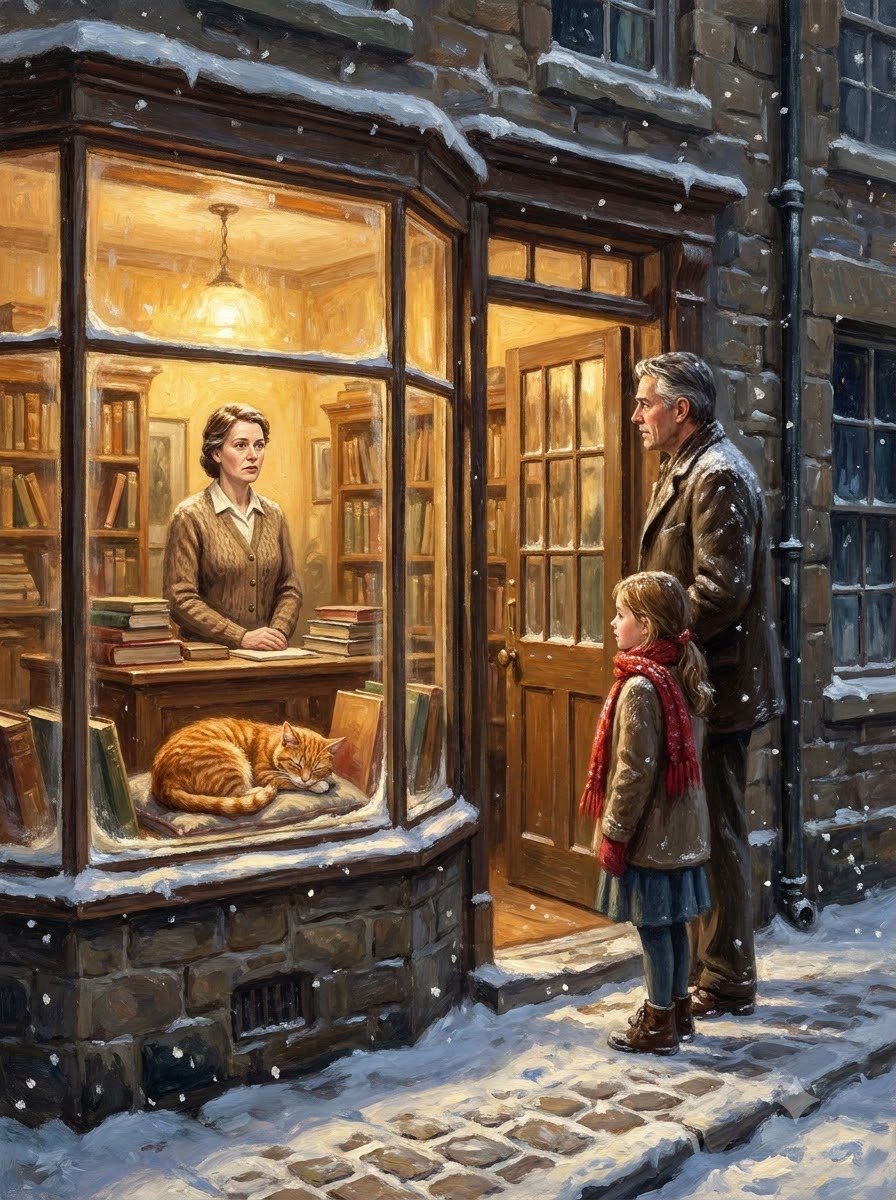
The bell over the door of Lindqvist Books rang at 3:40 on a Thursday afternoon in December, and a gust of snow blew in with it.
“Be right with you,” I called from the back, where I was wrestling a box of new paperbacks onto a cart.
My bookshop sat on a steep, crooked street in Duluth, Minnesota, two blocks up the hill from the gray, endless water of Lake Superior. It had creaky wooden floors, a cast-iron radiator that banged like a drum, and an orange cat named Tolstoy who slept in the front window and judged everyone who came in. I’d owned it for sixteen years. It was the only thing in my life that had never once disappointed me.
“Excuse me,” said a voice. A girl’s voice. “Do you have The Secret Garden? The one with the green cover?”
I came out from the back, wiping my dusty hands on my cardigan.
A girl of about twelve stood by the front table, snow melting in her dark curls. She had a red scarf wrapped around her neck three times and a backpack covered in enamel pins shaped like planets.
Behind her, a tall man was stamping snow off his boots on the mat, his head bent, unwinding a gray wool scarf.
“We do,” I said. “Children’s section, second shelf. I’ll show—”
The man looked up.
I stopped talking.
He was older. Of course he was older. There was gray at his temples now, and lines around his mouth, and he was thinner than I remembered, almost gaunt. But his eyes were the same dark brown. The same crooked eyebrow, the one that went up when he was surprised.
It was going up now.
“Anna,” Michael Reyes said softly.
The girl looked between us. Then she looked at me, very hard, her head tilted. Her eyes went wide.
“Oh my gosh,” she whispered. “You’re her. You’re the girl in the picture.”
I didn’t answer her. I couldn’t.
Twenty years ago, on a bright June morning, I had stood at the front of St. Paul’s Lutheran Church in a borrowed veil and my grandmother’s pearls, with a hundred and forty guests in the pews, waiting for this man to walk through the side door.
He never did.
At 11:20, his best man handed me a folded note. It said four words.
I’m sorry. I can’t.
I never saw him again. Until now.
“Get out,” I said quietly.
Chapter 2: The Note
He didn’t argue. He just nodded, put his hand on the girl’s shoulder, and said, “Come on, June. Let’s go.”
“But Dad—”
“June.”
The bell rang again as the door closed behind them. Through the frosted window, I watched them walk down the hill in the snow, the girl looking back over her shoulder at the shop.
I turned the sign on the door to CLOSED, sat down on the floor behind the counter, and shook.
Twenty years.
I’d met Michael Reyes when I was twenty-three, at a used bookstore in Minneapolis. We’d both reached for the same battered copy of East of Eden. He’d let me have it. Then he’d waited outside the store for forty-five minutes in the rain to ask if I’d tell him how it ended.
He was a high school chemistry teacher with terrible jokes and a laugh that took over his whole body. We were together for three years. He proposed on the shore of Lake Superior, in a snowstorm, on one knee in a foot of snow, with a ring he’d saved eight months to buy.
Six weeks before the wedding, he got quiet. He said it was nerves. He started canceling dinners. He lost weight. When I asked what was wrong, he kissed my forehead and said, “Nothing, Annie. I’m just tired.”
Two days before the wedding, he called and asked me if I was sure. If I really wanted to marry him. I laughed and told him I’d marry him in a burning building.
Then he left me at the altar.
After the wedding that didn’t happen, I didn’t leave my apartment for two weeks. His phone was disconnected. His apartment was empty. His school said he’d resigned by email. His mother wouldn’t return my calls. His best man, Kevin, told me he didn’t know anything, and I’d known Kevin long enough to know he was lying.
I moved to Duluth a year later. I took a job at a bookshop, and when the owner retired four years after that, I bought it with every penny I had. I dated a little. I almost got engaged once, to a kind, patient dentist named Paul. I couldn’t do it. I gave the ring back before he’d even finished asking.
I’d built a quiet, careful life where nobody could leave me at the front of a church ever again.
And he had just walked through my front door with a daughter.
Chapter 3: June
The girl came back the next day. Alone.
I was shelving new arrivals when the bell rang, and there she was in her red scarf and planet-pin backpack, snow in her hair, clutching a library card like a passport.
“I know you told us to get out,” she said in a rush, before I could speak. “But you didn’t specifically say me. You said it to my dad. And I really, really need to buy The Secret Garden because it’s for a school project, and you’re the only bookstore within walking distance of my aunt’s apartment, and also I have nine dollars.”
I stared at her. Despite everything, I almost laughed.
“Second shelf,” I said. “Children’s section.”
She found it, brought it to the counter, and laid her crumpled bills down one at a time. While I rang it up, she studied me with frank, unembarrassed curiosity.
“You really don’t remember me,” she said. “Obviously. You’ve never met me. But I feel like I know you.”
“Why is that?”
“Because there’s a picture of you in my dad’s wallet.” She said it like it was the most normal thing in the world. “You’re standing on a beach in the snow with your arms up, laughing. He’s had it in there as long as I can remember. When I was little, I thought you were a princess. Then I thought you were my mom’s sister. Then I asked him, and he said you were the bravest person he ever knew, and he made a mistake that he’d regret for the rest of his life.”
My hands had stopped moving on the register.
“Where’s your mom?” I asked carefully.
June’s face changed. Just a little.
“She died three years ago,” she said. “Car accident. On an icy road outside Minneapolis.” She picked at the edge of the book cover. “Dad was really sad for a long time. Then we moved in with my Aunt Teresa here because Dad got sick again and he needed help.”
“Sick again?”
June looked up at me, surprised.
“You don’t know?” she said. “He has leukemia. He had it a long time ago too, before I was born, and they fixed it. But it came back last spring.” She said it plainly, the way kids say terrible things they’ve had to say too many times. “That’s why we moved here. There’s a hospital in Duluth that does special transplants. He starts treatment after Christmas.”
The room tilted.
“A long time ago,” I repeated slowly. “When was the first time?”
June shrugged. “When he was young. Like, really young. Before he met my mom.” She tucked the book into her backpack. “He doesn’t like talking about it.”
Chapter 4: Kevin
That night, I did something I hadn’t done in twenty years.
I called Kevin Doyle, Michael’s best man.
I found his number through a mutual friend’s Facebook page. He picked up on the fourth ring, sounding wary, the way people do when they don’t recognize a number.
“Kevin,” I said. “It’s Anna Lindqvist.”
The silence on the line went on so long I thought he’d hung up.
“Annie,” he finally said, very quietly. “Wow. Okay. Hi.”
“He’s in Duluth,” I said. “Michael. He walked into my bookshop yesterday with his daughter. She told me he has leukemia. She said he had it before. Kevin, I need you to tell me the truth. Was he sick when he left me?”
Kevin let out a long, shaky breath.
“He made me swear,” he said. “Twenty years ago. On my mother’s life.”
“Kevin. Please.”
He was quiet for a moment. Then he told me.
Six weeks before our wedding, Michael had gone to the doctor for what he thought was a bad case of the flu that wouldn’t go away. They ran blood tests. Then more tests. Two days before the wedding, the oncologist called him with the results.
Acute myeloid leukemia. Aggressive. The doctor told him that without a bone marrow transplant, he probably had six months to live. With one, maybe a forty percent chance of surviving five years. And the treatment would be brutal: months of chemotherapy, isolation, hospitals.
“He came to my apartment that night,” Kevin said, his voice breaking. “He sat on my couch and cried for three hours. He kept saying, ‘She’s twenty-six, Kev. She’s twenty-six. I’m not going to make her a widow at twenty-seven. I’m not going to make her spend her whole first year of marriage watching me die in a hospital bed.'”
I pressed my hand over my mouth.
“I told him he was wrong,” Kevin said. “I told him you’d want to be there. That you’d never forgive him. He said, ‘I know. That’s the point. If she hates me, she’ll move on. If she loves me, she’ll stay, and I’ll ruin her life.'”
“So he left me at the altar,” I whispered. “On purpose.”
“He wanted you to hate him,” Kevin said. “It was the only way he could think of to set you free.”
“And he survived.”
“He survived,” Kevin said. “Barely. He was in the hospital for almost a year. His mother moved in with him. He found a bone marrow donor eleven months later. A stranger from Germany. He was in remission by the time he was thirty. He wanted to find you then. I told him you’d moved on. That you’d moved to Duluth and were engaged to a dentist.” Kevin’s voice cracked. “I thought I was protecting you. I’m so sorry, Annie.”
“I never married the dentist,” I said.
“I know that now,” Kevin said. “I didn’t then.”
Chapter 5: The Wallet
I found him the next afternoon at the coffee shop across the street from the hospital, sitting alone at a table by the window, with a cup of tea he wasn’t drinking.
He saw me come in and stood up so fast his chair scraped the floor.
“Anna,” he said. “I’m so sorry about the other day. I didn’t know you owned that shop. I swear, I didn’t know. June just wanted a book, and I—”
“Sit down, Michael.”
He sat.
I sat down across from him. For a long time, neither of us said anything.
“I talked to Kevin,” I said finally.
He closed his eyes.
“He made me promise not to tell you,” Michael said quietly. “No, wait. That’s backwards. I made him promise.”
“You let me think you didn’t love me,” I said. My voice was shaking. “For twenty years. Do you have any idea what that does to a person? I spent twenty years wondering what was wrong with me. What I did. Why I wasn’t enough for you to even say goodbye to my face.”
“I know,” he said, and his eyes were wet. “I know. And it was the worst decision I ever made. I was twenty-nine and terrified and I thought I was saving you. I thought I was being noble.” He laughed bitterly. “I wasn’t noble. I was a coward. I couldn’t stand the idea of you watching me waste away. So I took the choice away from you. That wasn’t love. That was fear dressed up as love.”
I looked at him across the table. At the gray in his hair. At the way his hands shook a little around the teacup.
“June says you keep my picture in your wallet,” I said.
He flushed. Then, slowly, he reached into his back pocket, pulled out a worn brown leather wallet, opened it, and slid it across the table toward me.
There it was. Behind a clear plastic sleeve, faded and creased. Me, at twenty-five, standing on the frozen beach of Lake Superior, arms flung up in the snow, laughing so hard my eyes were shut.
The day he proposed.
“Rachel knew,” he said quietly. “June’s mother. My wife. I told her everything on our second date. She said she didn’t mind. She said she’d rather marry a man who knew how to love someone that much than a man who’d never felt it at all.” He swallowed. “I loved her. I really did. We were happy. But I never took that picture out.”
I couldn’t speak.
“I’m not here to ask you for anything,” he said. “I’m sick again. My odds aren’t great this time either. I’m here for the transplant program, and because my sister lives here and can help with June. I swear I didn’t come looking for you. I’d never do that to you again.”
He reached across the table to take his wallet back.
I put my hand flat on top of it.
“You don’t get to decide that for me this time,” I said.
Chapter 6: The Second Chance
The transplant was scheduled for the second week of January.
Before that, Michael had to go through a round of chemotherapy so intense it would wipe out his immune system completely. He’d be in an isolation unit for weeks. Visitors had to wear masks and gowns and gloves.
His sister, Teresa, was a nurse who worked night shifts. June was twelve.
“Who’s going to take care of June while you’re in the hospital?” I asked him, the day after Christmas.
“Teresa will figure it out,” he said. “Her neighbor can watch her after school.”
“June can stay with me,” I said.
He stared at me. “Anna, you don’t have to—”
“I know I don’t have to,” I said. “I’m offering. She can do her homework at the shop after school. She can stay in my spare room on Teresa’s night shifts. Tolstoy likes her. Tolstoy doesn’t like anybody.”
So June moved into my life the way snow moves into a city: quietly, then all at once.
She did her homework at the big oak table in the back of the shop every afternoon, surrounded by stacks of books. She read The Secret Garden, and then Anne of Green Gables, and then every single Narnia book in three weeks. She asked me a thousand questions about her father when he was young, and I answered all of them honestly. About the bookstore in Minneapolis. About East of Eden. About the proposal in the snow.
“Were you really mad at him?” she asked one night, eating macaroni and cheese at my kitchen table.
“For twenty years,” I said.
“Are you still mad?”
I thought about it.
“I’m still a little mad,” I said. “But mostly I’m sad that we lost so much time.”
June nodded seriously. “My mom used to say that being mad at someone is like drinking poison and waiting for them to get sick.”
“Your mom sounds like she was very smart.”
“She was.” June poked at her macaroni. “She’d like you, I think. She’d say you’re good at being sad without being mean about it.”
I visited Michael every day in the isolation unit, in a yellow paper gown and a mask and blue rubber gloves. I read to him when he was too sick to talk. East of Eden, from the very first page. I’d never finished telling him how it ended.
On the worst night, when his fever spiked to 104 and the nurses moved quickly in and out of his room, he grabbed my gloved hand.
“If this doesn’t work,” he whispered, “will you make sure June—”
“Stop it,” I said. “You don’t get to leave me a note this time. You’re going to stay right here and finish this book.”
Chapter 7: Remission
The transplant worked.
It took four months. There were setbacks: infections, a terrifying week in February when his body started rejecting the donor cells, a night when the doctors called Teresa and me into a small room with a box of tissues on the table. But in May, his oncologist, a brisk, kind woman named Dr. Bergstrom, walked into his room with a folder and a smile.
“Complete remission,” she said. “No detectable disease. You’re not out of the woods. We’ll be watching you for years. But Michael, this is about as good as it gets.”
June screamed so loudly that a nurse came running from the station down the hall.
Michael came home to his sister’s apartment in June, thin and pale and bald, walking with a cane. He came to the bookshop every afternoon and sat in the armchair by the radiator with Tolstoy on his lap, reading.
We didn’t talk about what we were. We didn’t need to. Some things just grow back on their own, slowly, the way grass comes back in the spring after a long winter.
In August, he asked me to dinner. A real date. At a little Italian restaurant overlooking the harbor.
“I’m forty-nine,” he said, nervous, fiddling with his napkin. “I’ve had cancer twice. I have a twelve-year-old who reads more than I do and a sister who threatens to hurt me if I hurt you. I’m not exactly a great bet.”
“I know,” I said.
“I need you to know that if this goes badly again someday, I’m going to tell you,” he said. “Every scan. Every bad result. Every time I’m scared. I’m never going to make a choice for you again.”
“Promise?”
“I promise.”
I looked at him across the candlelight. The boy who’d waited forty-five minutes in the rain to ask me how a book ended. The man who’d carried my picture in his wallet for twenty years.
“Okay,” I said. “Then let’s try.”
Chapter 8: How the Story Ends
We got married the following June, on the beach of Lake Superior where he’d proposed twenty-two years earlier.
It was small. Just June, Teresa, Kevin, my best friend from the bookshop, a handful of neighbors, and Michael’s oncologist, Dr. Bergstrom, who said it was the first wedding of a former patient she’d ever been invited to and cried harder than anyone.
June was my maid of honor. She wore a yellow dress and gave a speech she’d written herself.
“Twenty-one years ago,” she said, reading carefully from her notecards, “my dad made a really big mistake. He thought that if he loved someone, he should protect them from sad things. But my mom taught me that you can’t protect people from sad things. You can only hold their hand while the sad things happen.” She looked up at us. “So Dad, this time, hold her hand. And Anna, don’t let go of his.”
Kevin had to sit down.
Michael wore a gray suit. He walked down the beach toward me himself. No cane. No side door. No note.
When he reached me, he took both of my hands. His were shaking.
“I’m here,” he whispered.
“I know,” I said. “You’re late, though.”
He laughed so hard he had to wipe his eyes.
We read our own vows. I didn’t write mine on paper. I’d been writing them in my head for twenty-one years.
“Michael,” I said, “the first time we met, you asked me how East of Eden ended. I never told you. Then you were gone, and I thought I’d never get the chance.” I squeezed his hands. “It ends with a single word. Timshel. Thou mayest. It means you get to choose. Even after everything, you still get to choose.”
Behind us, the gray water of Lake Superior rolled gently onto the sand.
“I choose you,” I said.
“I choose you,” he said. “Every single day I’ve got left.”
Afterward, June ran barefoot down the beach with her yellow dress hitched up to her knees. Teresa threw rice that drew every seagull in Duluth. Kevin hugged me so hard he lifted me off the ground and apologized for twenty years in my ear.
That night, back at the bookshop, Michael took his old brown wallet out of his pocket and slid out the faded photograph of me, laughing in the snow.
He set it on the shelf behind the register.
Then he took out his phone and showed me a new picture June had taken that afternoon: the two of us on the beach in the June sunshine, both of us older, both of us laughing so hard our eyes were shut.
“New picture for the wallet,” he said.
I kissed him under the creaky bookshelves while Tolstoy watched from the front window, judging us both.
And this time, nobody left.
The End.
Midnight Chapters publishes original fiction. All names, characters, places, and events in this story are imaginary. Any resemblance to real persons or events is coincidental.