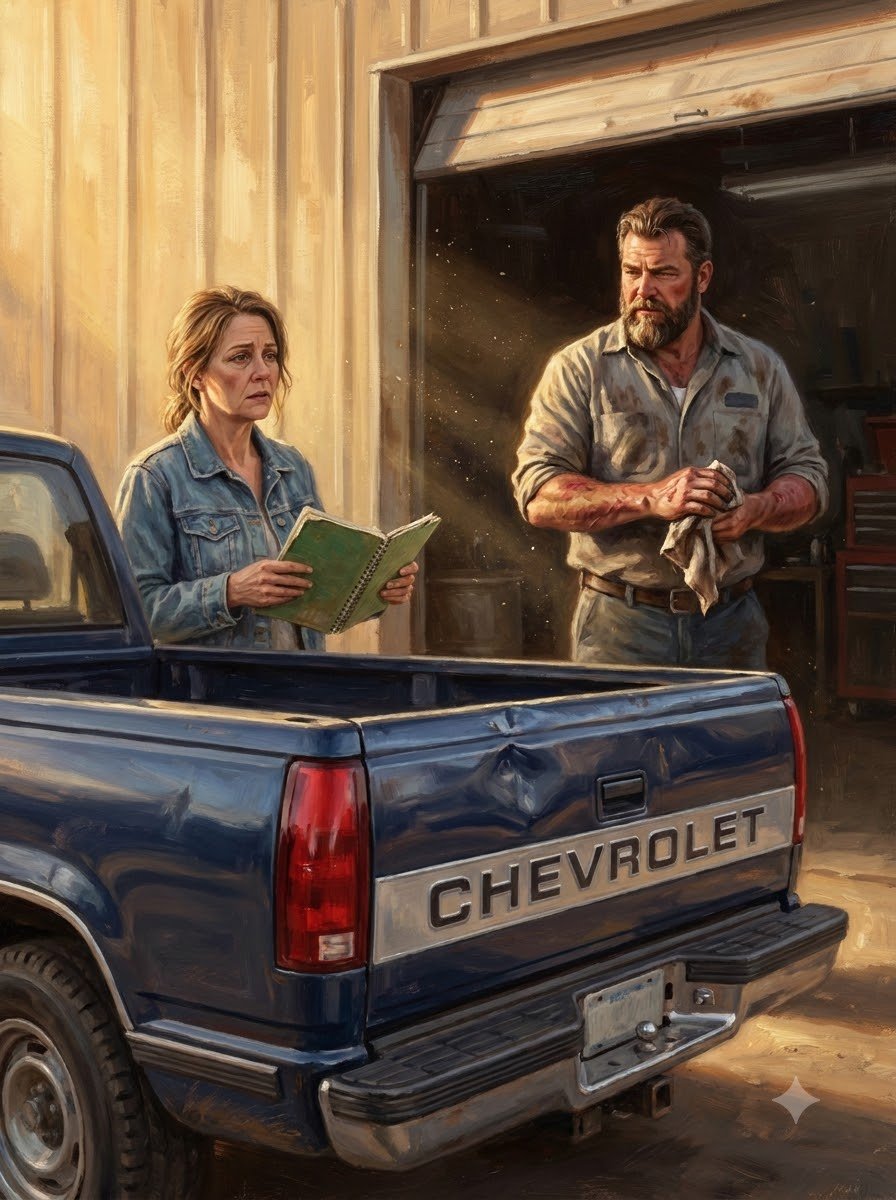
Eighteen months after her husband died, Dana Whitaker’s old pickup broke down on a Texas highway. The mechanic who towed it fixed it for free, then kept refusing her money for every repair after. He wouldn’t say why. The answer was waiting in the one thing of Paul’s she hadn’t been able to open. Read all 8 chapters below.
A Midnight Chapters original story. All characters and events are fictional.
Chapter 1: Smoke on Route 287
The truck died on a Tuesday afternoon in August, eleven miles north of Amarillo, with a sound like a coffee can full of bolts and a cloud of white smoke that rolled over the hood and swallowed the windshield.
I coasted onto the shoulder and sat there with my hands on the wheel, listening to the engine tick as it cooled.
It was Paul’s truck. A 2004 Ford F-150, navy blue, with a dented tailgate and a cracked dashboard and a little plastic hula girl stuck above the radio that he’d bought at a truck stop in Barstow on our honeymoon. For twenty-eight years of marriage, he’d kept it running himself, every weekend, lying on a creeper in our garage with the radio tuned to old country.
He’d been gone eighteen months. Heart attack, at fifty-four, in the cab of his semi at a rest stop in Oklahoma. He’d been a long-haul trucker for thirty years.
I didn’t know the first thing about engines. I’d never needed to.
I called three tow companies. Two didn’t answer. The third said it would be four hours.
Forty minutes later, a battered white tow truck pulled onto the shoulder behind me. Painted on the door in faded red letters: ORTEGA AUTO · AMARILLO · SINCE 2011.
A man climbed down from the cab. He was maybe forty, broad and solid, with a gray-streaked beard and forearms covered in old burn scars. He wore grease-stained coveralls with the name LUIS stitched over the pocket.
“Ma’am,” he said. “Saw the smoke from the overpass. You all right?”
“I’m fine. The truck isn’t.”
He popped the hood, waved away the last of the steam, and looked inside for a long time without saying anything.
Then he looked at the dented tailgate. At the hula girl on the dashboard. At me.
Something passed over his face. He looked like a man who’d seen a ghost.
“This was Paul Whitaker’s truck,” he said quietly.
My heart jumped. “You knew my husband?”
He hesitated. Just a second too long.
“Everybody in this business knew Paul,” he said. He closed the hood. “Water pump’s gone, and you’ve cracked a radiator hose. I can tow you in and have her running by Friday.”
“How much?”
He was already hooking the chains to the front axle.
“We’ll worry about that on Friday,” he said.
Chapter 2: No Charge
On Friday, I drove my neighbor’s car to Ortega Auto, a small cinderblock garage on the east side of town with two service bays, a hand-painted sign, and a chain-link fence. Inside, a radio was playing old country. George Strait. The same station Paul used to listen to.
The truck was parked out front, washed and waxed, gleaming in the sun. I’d never seen it so clean.
Luis came out of the office wiping his hands on a rag.
“She’s ready,” he said. “New water pump, new hoses, new thermostat while I was in there. Your belts were cracked, so I replaced those too. Changed the oil. Rotated the tires.”
I took out my checkbook. “What do I owe you?”
“Nothing.”
I looked up. “Excuse me?”
“No charge, Mrs. Whitaker.”
“That’s ridiculous. That must be eight hundred dollars of work.”
“Closer to eleven.” He shrugged. “No charge.”
“Mr. Ortega, I don’t take charity.” I could feel my face going hot. Since Paul died, I’d had more casseroles than I could eat, more sympathy cards than I could read, and more people looking at me with soft, sorry eyes than I could stand. “I’m a widow. I’m not helpless.”
“I know you’re not, ma’am.” He looked at the truck, not at me. “It’s not charity. It’s a debt.”
“I don’t owe you anything, and you don’t owe me anything. We’ve never met.”
“Paul did me a kindness once,” he said. “A long time ago. I’m just paying it back.”
“What kindness?”
He looked at me for a long moment. Then he shook his head.
“That’s not mine to tell,” he said. “Drive safe, Mrs. Whitaker.”
He walked back into the garage before I could argue. I stood there in the parking lot with my checkbook open, completely furious.
I drove home. But I couldn’t stop thinking about it.
Three weeks later, the truck’s alternator went. I took it to a different garage across town on purpose. They quoted me six hundred dollars. When I went to pick it up, the woman at the front desk looked at her computer screen and frowned.
“Says here it’s been paid,” she said.
“By who?”
“Cash. Guy came in this morning. Didn’t leave a name.” She paused. “Big fella. Burns on his arms.”
Chapter 3: The Boy in the Photograph
After that, I started paying attention.
When my front brakes started squealing in October, a note appeared under my windshield wiper in the church parking lot: Bring her by. Brakes are on me. —L.
When I got a flat tire on Thanksgiving morning, a white tow truck happened to be passing the Walmart lot ten minutes later.
When the transmission started slipping just before Christmas, I took it back to Ortega Auto, mostly because I wanted to confront him.
“This has to stop,” I told him. “I mean it. Either you tell me why, or I’m selling this truck.”
Luis set down his wrench. He looked genuinely stricken. “Don’t sell Paul’s truck, Mrs. Whitaker. Please.”
“Then tell me.”
He looked down at his scarred forearms. For a moment, I thought he might actually tell me.
Then a teenage boy came out of the second bay, holding an air filter. He was maybe sixteen, skinny, with a shaved head and a tattoo of a broken heart on his neck.
“Luis, is this the right one?”
“That’s the one, Marco. Good eye.” Luis watched him go back to the bay. Then he said quietly, “He’s one of mine. Got out of juvenile detention in September. Stole three cars before he was fifteen. Now he can rebuild a carburetor in under an hour.”
“One of yours?”
“I take two or three kids a year from the juvenile program. Teach them the trade. Give them a reason to show up somewhere every morning.” He turned back to the transmission. “Somebody did it for me once.”
On the wall of the tiny office behind him, I noticed a framed photograph I’d never seen before. It was old and faded, the colors gone yellow. It showed a skinny teenage boy with a shaved head, sitting on the tailgate of a navy blue pickup truck, holding a socket wrench and grinning.
Standing next to the boy, with one hand on his shoulder, wearing a trucker’s cap I’d have known anywhere, was my husband.
I stared at it. The boy in the photo had burn scars on both forearms.
“That’s you,” I whispered.
Luis didn’t turn around.
“That’s my husband,” I said, louder. “That’s Paul. That’s this truck.”
“Yes, ma’am.”
“When was this taken?”
“Spring of 2004.”
“I’ve never seen this picture in my life. Paul never said a word about you.” My voice was shaking. “Twenty-eight years, and he never said a word.”
Luis finally turned to face me. His eyes were wet.
“I asked him not to,” he said. “I was ashamed. And then, later, I think he just didn’t know how to explain me.” He swallowed. “Mrs. Whitaker, did Paul keep a red toolbox? Snap-on, with a busted latch?”
I thought of the toolbox sitting on the workbench in our garage. I hadn’t touched it since the funeral. I couldn’t. I hadn’t even been able to open the garage door for months.
“Yes,” I said.
“Then I think everything you want to know is in there,” Luis said quietly. “He told me once that’s where he kept the things that mattered.”
Chapter 4: The Red Toolbox
I didn’t open it that night.
I sat in the kitchen until two in the morning with a cup of coffee going cold, looking at the door to the garage.
For thirty years, that garage had been Paul’s church. When he was home from the road, he’d spend every Saturday out there, with the radio on and the door rolled up, tinkering with the truck, fixing neighbors’ lawnmowers, building birdhouses. I used to bring him iced tea and sit on an overturned bucket and watch him work.
After he died, I’d closed the door and never opened it again.
At 2:15, I got up, walked through the laundry room, and pushed it open.
The garage smelled like motor oil and sawdust and, faintly, impossibly, like Paul. His creeper was still leaning against the wall. His work gloves were still on the bench, shaped like his hands.
The red Snap-on toolbox sat at the end of the workbench. The latch on the top drawer was broken, held closed with a twist of baling wire.
I untwisted the wire with shaking fingers.
The top drawer didn’t have tools in it. It had papers. A thick bundle of them, tied with string. And a small spiral notebook with a cracked green cover.
I opened the notebook first. It was Paul’s handwriting, blocky and careful, the way he wrote everything.
March 12, 2004. I-40 eastbound, mile marker 81. Stolen Camaro rolled into the median. On fire. Kid inside. Pulled him out. He’s 15. Burns on his arms, but he’ll live. Name is Luis Ortega.
March 20. Visited the kid at the burn unit. No family came. Mom’s in prison. Dad’s gone. He’s going to juvie when he gets out. He says he steals cars because he likes engines. Said he could hotwire anything before he could ride a bike. Asked him if he wanted to learn to fix them instead.
April 2004. Got permission from the juvenile court to take Luis out on Saturdays. Brought him to the garage. Dana’s at her sister’s in Lubbock. Kid’s a natural. Rebuilt the carburetor on the Ford in four hours.
I put my hand over my mouth.
In April 2004, I had gone to Lubbock for three weeks to take care of my sister after her hysterectomy. I remembered Paul being strangely cheerful on the phone. I remembered coming home to a truck that ran smoother than it ever had.
The entries went on for years.
2006. Luis got his GED. Proudest day of my life since I married Dana.
2007. Paid Luis’s first semester at Amarillo College, auto tech program. Told him it was a scholarship. Took the money out of my overtime so Dana wouldn’t worry about the budget.
2009. Luis graduated. Top of his class. He cried. I cried. Don’t tell anybody.
2011. Luis opened his own garage. Ortega Auto. Co-signed the loan. Told the bank I’m his uncle. Close enough.
The last entry was dated two weeks before Paul died.
Stopped by the garage. Luis has three kids from juvie working for him now. Said he’s doing for them what I did for him. That’s the whole point, isn’t it? You fix one thing, it fixes the next thing.
I should tell Dana. I’ve meant to for twenty years. I don’t know why I never did. I think I was afraid she’d think I was a fool for sticking my neck out for a car thief. Next time I’m home, I’ll tell her.
He never came home.
Chapter 5: What Paul Never Said
I drove to Ortega Auto the next morning at seven, before the garage was even open.
Luis was already there, unlocking the bay doors. He saw the green notebook in my hand and went very still.
“Why didn’t you tell me?” I said. “At the funeral. You were at the funeral, weren’t you? You must have been.”
“I stood in the back,” he said quietly. “I left before the service ended. I didn’t think I had the right to be there.”
“You had every right.” My voice cracked. “He wrote about you like you were his son. For twenty years, he was raising a son, and I didn’t even know you existed.”
“He wanted to tell you.” Luis’s voice was rough. “Every year, he’d say, ‘This year I’m going to bring you home for Thanksgiving, Luis, and Dana’s going to feed you until you can’t move.’ And every year, something happened. I got scared. Or he got scared. I think he was afraid you’d be angry about the money.”
“I would have been angry,” I said honestly. “For about a day.”
Luis laughed. It sounded like it hurt.
“We couldn’t have kids,” I said. I hadn’t meant to say it. “Paul and I. We tried for years. It just never happened. He always said it was okay, that he didn’t need to be a father.” I wiped my eyes. “And all that time, he was being one. Out here. Without me.”
Luis didn’t say anything. He just stood there, in the cold December morning, with his scarred hands hanging at his sides.
“Mrs. Whitaker,” he finally said, “when Paul died, I didn’t know what to do with myself. I’d lost the only father I ever had. And I couldn’t even tell anyone, because nobody knew.” He looked at the truck. “When I saw that truck on the side of the road, smoking, with you sitting in it looking so lost, I thought, okay. This is the one thing I can still do for him.”
“So you’ve been taking care of me,” I said. “For months.”
“Somebody had to.” He tried to smile. “You’re terrible about oil changes, ma’am.”
I laughed. Then I cried. Then I did something I hadn’t done with anyone in eighteen months.
I hugged him.
He stood stiff for a second, like he didn’t know what to do. Then his big arms came around me, and he held on.
Chapter 6: The Garage Door
That afternoon, Luis followed me home in his tow truck.
I opened the garage door all the way for the first time since the funeral. Sunlight poured in over Paul’s workbench, his creeper, his gloves.
Luis stood in the doorway for a long time.
“I haven’t been in here since 2010,” he said. “It’s exactly the same.”
“I couldn’t touch anything.”
He walked to the workbench and ran his hand along the edge of it, the way you’d touch an old friend’s shoulder. On the pegboard above it, he found a socket wrench hanging in its place, and he took it down and turned it over in his hand.
“He gave me this one,” he said. “The first Saturday. I hotwired his truck to show off, and instead of yelling at me, he handed me this and said, ‘Okay, smart guy. Now show me you can put something back together.'”
We spent the whole afternoon in the garage. He told me stories. Paul teaching him to change a tire in the rain. Paul showing up at his GED ceremony in a tie for the first and only time. Paul sitting in the front row at his college graduation, clapping so loudly that the dean stopped speaking. Paul co-signing the bank loan and lying to the loan officer with a perfectly straight face.
I told him stories too. Paul proposing to me at a Dairy Queen in Tucumcari with a ring made from a twist tie because he’d forgotten the real one at home. Paul crying at every single episode of a dog rescue show. Paul burning toast every morning for twenty-eight years because he refused to adjust the toaster.
By the time the sun was going down, we were both laughing.
“He talked about you all the time, you know,” Luis said. “Every Saturday. ‘Dana says this, Dana thinks that, Dana would kill me if she knew I was out here with you.'” He grinned. “I felt like I knew you already.”
“I wish I’d known you,” I said.
He was quiet for a moment.
“Mrs. Whitaker,” he said, “can I ask you something?”
“Dana. Please.”
“Dana.” He turned the socket wrench over in his hands. “I’ve got six kids from the juvenile program on my waiting list right now. I can only take three. I don’t have the space. I don’t have the time. And honestly, a lot of them don’t just need someone to teach them engines. They need someone to sit with them, help with their homework, make sure they’re eating, tell them when they’re being idiots.” He looked around the garage. “Like Paul did for me.”
“What are you asking me?”
“I’m asking if you’d consider letting me use this garage,” he said slowly. “On Saturdays. For a few of the kids. And if you’d consider being here. Not to fix engines. Just to be here.”
Chapter 7: Saturday Mornings
The first Saturday, three boys showed up in my driveway at eight a.m.
Marco, the sixteen-year-old with the broken-heart tattoo. A silent, skinny fifteen-year-old named DeShawn who wouldn’t look anyone in the eye. And a seventeen-year-old named Tyler who had stolen his foster father’s car and driven it into a canal.
I had no idea what I was doing.
So I did what I knew how to do. I made breakfast. Eggs and bacon and biscuits and a whole pot of coffee. The boys ate like they hadn’t seen food in a week. Marco had three helpings. DeShawn ate in total silence, hunched over his plate like someone might take it from him.
Then Luis rolled up the garage door, turned on the radio to the old country station, and started teaching them how to rebuild the transmission on Paul’s truck.
I sat on an overturned bucket with a glass of iced tea and watched.
It became a routine.
Every Saturday, the boys came. Sometimes three, sometimes five. Luis taught them engines. I taught them other things. How to fill out a job application. How to cook a box of pasta. How to write a thank-you note. DeShawn turned out to be reading at a third-grade level, so I started reading with him at the kitchen table after lunch, the way my mother had read with me.
By February, DeShawn was reading the sports section of the newspaper out loud to the other boys. By April, he was reading The Outsiders. He finished it on a Saturday afternoon in May, sitting on Paul’s workbench, and closed it, and looked up at me with his eyes shining.
“Mrs. Dana,” he said, “can I borrow another one?”
It was the first time he’d ever started a conversation.
I went inside to my bedroom and cried for twenty minutes.
Chapter 8: You Fix One Thing
A year after the truck broke down on Route 287, the Paul Whitaker Saturday Program had eleven kids enrolled.
We’d outgrown my garage. Luis rented the empty lot next to Ortega Auto, and half of Amarillo showed up to help build a second garage on it: retired mechanics, church volunteers, the high school shop teacher, three of Paul’s old trucking buddies who drove in from as far as Tulsa.
Over the new bay door, Luis hung a hand-painted sign.
THE WHITAKER SHOP · You fix one thing, it fixes the next thing.
Marco got hired full-time at a dealership in Lubbock. Tyler enlisted in the Army as a mechanic. DeShawn was accepted into the auto tech program at Amarillo College, the same one Luis had gone to. I wrote him a check for his first semester and told him it was a scholarship.
Close enough.
On the anniversary of Paul’s death, Luis and I drove the truck out to the rest stop in Oklahoma where Paul had died. We sat on the tailgate in the hot wind, eating gas station sandwiches, not saying much.
“Do you think he’d be mad?” I asked. “That I found out this way? That I took over his secret?”
Luis laughed softly.
“Dana,” he said, “I think he planned it. I think he left that notebook in the toolbox knowing exactly who would eventually open it.”
I looked out at the endless flat highway, shimmering in the heat.
“I spent eighteen months thinking I’d lost everything,” I said. “My husband. My whole life. I didn’t think I’d ever have a reason to open the garage door again.”
“And now?”
“Now I have eleven teenagers eating me out of house and home every Saturday,” I said, “and a mechanic who won’t let me pay for anything.”
“That’s not changing,” Luis said.
“I know.”
He reached into his pocket and pulled out something small. He pressed it into my hand.
It was a key ring. On it was a single key, brass, worn smooth.
“Paul gave me this the day I opened my garage,” Luis said. “It’s the spare key to his truck. He said, ‘If anything ever happens to me, you take care of her.'” He paused. “I always thought he meant the truck.”
I closed my hand around the key and held it against my chest.
Above the dashboard, the little plastic hula girl from Barstow swayed in the wind.
“He meant both of us,” I said.
The End.
Midnight Chapters publishes original fiction. All names, characters, places, and events in this story are imaginary. Any resemblance to real persons or events is coincidental.