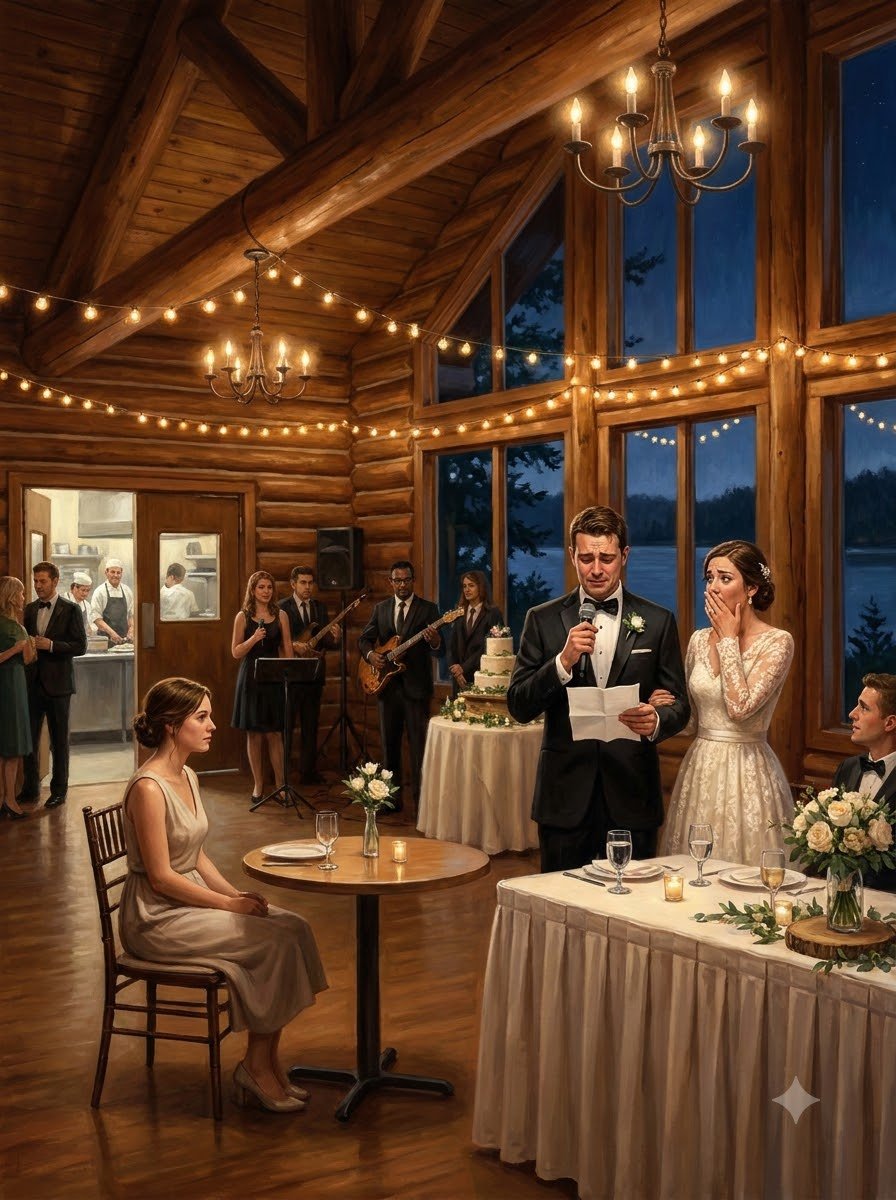
At her own wedding reception, Megan’s younger sister picked up the microphone and spent five minutes mocking her in front of two hundred guests. Everyone laughed. Megan said nothing, the way she always had. Then the groom stood up, took a folded piece of paper out of his jacket, and said, “I wrote a speech too.” Read all 8 chapters below.
A Midnight Chapters original story. All characters and events are fictional.
Chapter 1: The Toast
The reception was at a lakeside lodge near Lake Tahoe, all pine beams and string lights and floor-to-ceiling windows looking out over dark blue water. My sister, Brooke, had wanted a wedding that looked like a magazine cover. She got one.
I was seated at table nine, near the kitchen doors, between a great-aunt who was mostly deaf and a college friend of the groom’s who kept checking his fantasy football scores.
Not at the head table. Not as maid of honor. Brooke had asked her friend Kelsey to do that six months ago, in a text that said, It’s just easier this way, Meg. You understand.
I understood. I always did.
After dinner, the DJ tapped the microphone. “And now, a few words from the beautiful bride!”
Brooke stood up in her lace mermaid gown, glowing, champagne in hand. She was twenty-seven, three years younger than me, blond and bright and effortlessly charming, the kind of person rooms rearranged themselves around. Next to her, her new husband, Ethan, smiled up at her. He was a quiet, steady engineer with kind eyes. I’d met him exactly four times before today, and every time, he’d asked me real questions and actually listened to the answers.
Brooke thanked our parents. She thanked Ethan’s family. She thanked her bridesmaids, one by one. Then she turned toward the back of the room, toward table nine, and her smile changed.
“And of course,” she said, “I have to thank my big sister, Megan.”
A spotlight swung toward me. I froze with my fork halfway to my mouth.
“Megan’s always been the family’s little project,” Brooke said sweetly. “When we were kids, Mom used to say, ‘Brooke, be patient with your sister, she tries her best.'” A few people chuckled. “And she does! She really does. She tried college. She tried marriage. She tried that little catering business.” Brooke laughed. “Bless her heart, she’s still trying!”
More laughter. Louder now.
“So, Megan,” Brooke said, raising her glass toward me, “I just want you to know, no matter how many times you mess up your life, you’ll always have a seat at my table.” She paused. “Near the kitchen, of course. Where you’ll feel at home.”
The room exploded with laughter. Someone at the bridesmaids’ table actually whooped.
My face was burning. I set my fork down carefully so my hand wouldn’t shake. Across the room, my mother looked down at her plate. My father, in his wheelchair at the end of the family table, frowned and opened his mouth, but my mother laid her hand on his arm.
I did what I always did. I smiled, and nodded, and raised my water glass back at her, like it was all in good fun.
Brooke sat down to applause, kissing Ethan on the cheek.
Ethan didn’t kiss her back.
He was staring at the tablecloth. His jaw was tight. Then, slowly, he pushed back his chair and stood up.
The DJ, confused, held out the microphone. Ethan took it.
He reached into the inside pocket of his tuxedo jacket and pulled out a folded sheet of paper.
“I wasn’t planning to say anything tonight,” he said, his voice calm and clear. “But I wrote a speech too. And I think everyone should hear it.”
Brooke’s smile froze. “Babe, what are you doing?”
Ethan unfolded the paper.
“This one,” he said, “is the real one.”
Chapter 2: Eleven Months Earlier
To understand what Ethan was about to read, you have to go back eleven months, to the morning my father had a stroke.
He was sixty-one. He’d been a high school shop teacher in Sacramento for thirty years and still fixed every broken thing in the neighborhood for free. He collapsed in his garage while building a birdhouse for Brooke’s wedding favors. My mother found him there forty minutes later.
He survived. But his left side was paralyzed, and the doctors said he’d need months of intensive inpatient rehabilitation to have any chance of walking again.
Their insurance covered six weeks.
I was in the hospital waiting room when the billing coordinator explained it to my mother. I watched my mother’s face crumple. Rehab beyond six weeks would cost about nine thousand dollars a month. My parents had a mortgage, a little savings, and two daughters.
Brooke was there too. She’d been crying for hours, mascara streaked down her face, holding my mother’s hand.
“We’ll figure it out, Mom,” Brooke said. “Ethan and I will help. Whatever it takes.”
Three days later, she called me.
“Meg, I can’t,” she said. “We’ve already put down deposits on the venue and the dress and the photographer. If we pull out now, we lose everything. You get that, right? You don’t have a wedding to pay for. You don’t have anything going on.”
I had a two-bedroom apartment in Reno, a small catering business that was finally starting to break even after my divorce, and twenty-three thousand dollars in savings that I’d spent four years putting away to open a real storefront.
“It’s fine,” I said. “I’ll handle it.”
“You’re the best,” Brooke said. “But maybe don’t tell Mom and Dad it’s coming from you. You know how proud Dad is. It’ll be easier if they think it’s from the family. From all of us.”
So I didn’t tell them.
I drained my savings. I sold my catering van and rented one by the day instead. I picked up weekend shifts at a hotel restaurant. I paid for four extra months of my father’s rehab, a wheelchair ramp for their house, and, when they fell behind, three of their mortgage payments.
I set up the transfers to come from an account my parents wouldn’t recognize, and I asked the rehab center to list the payer as “family.”
And at Thanksgiving, I sat at my parents’ table and listened to my mother cry and thank Brooke and Ethan for their generosity.
Brooke smiled and squeezed Mom’s hand. “That’s what family does,” she said.
She didn’t look at me once.
Chapter 3: The Envelope
I didn’t know Ethan had found out until three weeks before the wedding.
He called me on a Tuesday night. It was the first time he’d ever called me.
“Megan,” he said. “I’m sorry to bother you. I’m at your parents’ house. Your dad asked me to help him sort out some insurance paperwork for the rehab center. There’s a problem with a claim.” He hesitated. “I’m looking at the payment records.”
My stomach dropped.
“Ethan—”
“The transfers came from an account in your name,” he said quietly. “Every one of them. Thirty-eight thousand dollars.”
I didn’t say anything.
“Brooke told me,” he said slowly, “that you refused to help. She said she asked you, and you said you couldn’t afford it and that Dad should have saved better. She said that’s why she and I had to cover it. I offered to put money in last fall. She told me she’d already taken care of it out of her savings, and that it would hurt her pride if I asked about it.”
“Please don’t tell my parents,” I said. My voice cracked. “Please. It doesn’t matter who paid. Dad’s walking with a cane now. That’s all that matters.”
“It matters to me,” Ethan said.
“Ethan, you’re marrying her in three weeks.”
He was quiet for a long time.
“I know,” he said. “That’s exactly why it matters.”
He asked if he could see me. I said no. He asked again, and I said no again.
The next morning, a manila envelope showed up in my mailbox. Inside was a printout of the rehab center’s payment ledger, my name highlighted on every page. And a handwritten note.
I’m not going to do anything without talking to you first. But I need to understand who I’m marrying. Will you tell me the truth? About all of it? —Ethan
I sat on my kitchen floor with the envelope in my lap and cried for an hour.
Then I called him back.
Chapter 4: What Brooke Said About Me
We met at a coffee shop in Truckee, halfway between Reno and the lodge where he and Brooke were finalizing the wedding details.
I told him everything. Not to get revenge. I told him because I was tired, and because for the first time in my life, someone had asked.
I told him about the college scholarship essay I wrote my senior year of high school, the one about my father’s workshop, which disappeared from my backpack two days before the deadline. The same essay, word for word, won Brooke a regional writing award three years later. When I confronted her, she cried and told our parents I was jealous and trying to steal credit for her work. They believed her.
I told him about my ex-husband, Jason, and how Brooke had messaged him privately during our worst year, telling him I’d been seen out with another man. It wasn’t true. It didn’t matter. It was the beginning of the end.
I told him about the three thousand dollars that went missing from my mother’s jewelry box when I was twenty-two. Brooke said she saw me in my mother’s bedroom that afternoon. I was in Reno that afternoon, at a job interview. Nobody checked. My mother didn’t speak to me for four months.
I told him how Brooke had always been the bright one, the charming one, the one who cried first and loudest. How every story somehow became my fault. How, after a while, I stopped defending myself because it never worked, and it just made everyone sad.
Ethan listened without interrupting. When I finished, he sat for a long time, turning his coffee cup in his hands.
“Why didn’t you ever fight back?” he finally asked.
“Because she’s my sister,” I said. “Because my parents love her. Because I kept thinking if I was good enough, quiet enough, generous enough, someday she’d stop.”
“And did she?”
I laughed, but it came out broken. “Ask me after the wedding.”
Ethan looked at me with an expression I couldn’t read.
“I’m not going to ask you to do anything,” he said finally. “I’m not going to make you choose. But I’m also not going to marry a woman and spend the rest of my life pretending I don’t know who she is.”
“So you’re going to call it off?”
“I’m going to give her a chance,” he said. “One chance. I’m going to watch how she treats you at the wedding. If she’s kind to you, if she shows me even one sign that she’s not who you’ve described, I’ll let it go. I’ll talk to her privately, after. We’ll work through it.”
“And if she isn’t kind?”
He folded his napkin carefully into a small square.
“Then I’ll make sure she never gets to rewrite you again,” he said.
Chapter 5: The Real Speech
Back in the ballroom, two hundred guests had gone completely silent.
Ethan held the folded paper in one hand and the microphone in the other. Beside him, Brooke had gone pale under her makeup.
“Ethan,” she hissed. “Sit down. You’re embarrassing me.”
He didn’t sit down.
“Brooke just told you all that her sister Megan is the family’s little project,” he said. “I want to tell you about Megan too. Because I’ve learned a lot about her in the last few weeks.”
He looked down at the paper.
“Eleven months ago, my father-in-law, Tom, had a stroke,” Ethan read. “Most of you know that. Most of you also know that he’s here tonight. That this afternoon, he walked his daughter halfway down the aisle on his own two feet, with a cane, before he had to sit down.”
Several people turned to look at my father. He was gripping the arms of his wheelchair.
“What most of you don’t know,” Ethan said, “is that his insurance ran out after six weeks. And the person who paid for the next four months of rehab, the reason Tom can walk at all, wasn’t Brooke. It wasn’t me. It was Megan.”
A wave of murmuring rippled across the room.
“Megan sold her catering van,” Ethan read. “She emptied the savings she’d been putting away for four years to open her own business. She paid for Tom’s rehab, a wheelchair ramp, and three months of his mortgage. And she asked the rehab center not to put her name on it, because she didn’t want her parents to feel ashamed.”
He looked up from the paper and straight at Brooke.
“And then she sat at Thanksgiving dinner,” he said, “and watched her sister take the credit.”
Brooke’s face went from pale to red. “That’s a lie,” she said loudly. “Megan’s been jealous of me my whole life, and now she’s poisoning you against—”
“I’ve seen the payment records, Brooke,” Ethan said calmly. “Every page. Her name is on every page.”
At the family table, my mother had both hands pressed over her mouth.
Slowly, with a scrape of metal, my father pushed himself up out of his wheelchair. He grabbed the cane hooked over the handle, braced himself against the table, and stood. It took him almost ten seconds. The whole room watched.
He looked across the ballroom at me, at table nine, by the kitchen door.
“Megan,” he said hoarsely. “Is that true?”
I couldn’t speak. I just nodded.
My father’s face crumpled.
“Why didn’t you tell me?” he whispered.
“Because she told me not to,” I said, and my voice finally broke. “She said it would hurt your pride.”
Chapter 6: Brooke’s Last Card
For a second, nobody moved.
Then Brooke snatched the microphone out of Ethan’s hand.
“Oh, my God,” she said, laughing a high, brittle laugh. “Okay. Everyone, I’m so sorry. This is so embarrassing. Can we just be honest about what’s really happening here?”
She turned toward me, eyes shining with tears.
“My sister has been meeting my fiancé behind my back for weeks,” she said, her voice trembling perfectly. “I’ve seen the texts. I didn’t want to say anything on my wedding day, but she’s obviously turned him against me so she can have him for herself. She’s done this before. She did it with my prom date. She’s sick.”
The room erupted in shocked whispers. Heads swiveled toward me.
I felt like I was going to throw up.
Before I could say anything, my mother stood up.
My mother, Linda, was a quiet woman. She didn’t like scenes. She’d spent thirty years smoothing over every fight between Brooke and me, usually by asking me to apologize first.
She walked to the head table, took her phone out of her purse, and held it up.
“Megan didn’t do anything behind your back, Brooke,” she said, her voice shaking. “Because Ethan called me before he met with her. Three weeks ago. He asked me if I thought it was all right.” She looked at Ethan, and he nodded. “And Megan sent me every message they ever exchanged, last night, after the rehearsal dinner. Because she didn’t want me to be surprised today.”
Brooke stared at her.
“Megan asked him not to say anything,” my mother continued, tears streaming down her face. “She begged him. She told him she’d rather keep paying in secret for the rest of her life than embarrass you at your wedding. I read every word.”
She turned to the room, to two hundred people holding champagne glasses.
“My older daughter,” she said, “is the most generous person I have ever known. And I let her sit near the kitchen door at her own sister’s wedding, because I’ve spent her whole life asking her to make herself smaller so everyone else could be comfortable.”
Then my mother walked across the ballroom, past the dance floor, past the bridesmaids, straight to table nine, and put her arms around me.
“I’m so sorry, baby,” she whispered into my hair. “I’m so, so sorry.”
Behind her, Brooke threw the microphone onto the head table with a horrible screech of feedback, gathered her lace train in both fists, and ran out of the ballroom.
Nobody followed her.
Chapter 7: The Morning After
Ethan filed for an annulment four days later.
He came to my apartment in Reno to tell me in person. He looked exhausted. He’d lost weight.
“I’m sorry,” I said. “I never wanted this.”
“I know,” he said. “That’s the difference between you two.” He sat on the edge of my sofa, his hands clasped between his knees. “I spent three days at my parents’ house trying to convince myself I’d made a mistake. That I’d humiliated her for no reason. Then I found out she’d told my mother on our wedding night that you’d been trying to seduce me for months, and that she’d only included you in the wedding out of pity.” He shook his head. “She wasn’t sorry. She was just angry she got caught.”
He stood up to leave. At the door, he turned back.
“For what it’s worth,” he said, “I think you’re going to be okay. I think you’re going to be better than okay.”
After he left, my parents drove up from Sacramento.
My father walked into my apartment on his own, with his cane, slowly but steadily. He sat down at my small kitchen table and looked around at the rented catering equipment stacked in the corner, the boxes of to-go containers, the bulletin board covered in handwritten orders.
“You sold your van,” he said quietly.
“It’s fine, Dad.”
“It’s not fine.” He reached across the table and took my hand in his good one. His grip was weak, but steady. “You gave up your dream so I could walk. And I thanked the wrong daughter.”
“You didn’t know.”
“I should have known,” my mother said from the doorway, crying again. “There were a hundred times I should have known, and every single time it was easier to believe her.”
They didn’t stay long. When they left, my father pressed an envelope into my hand. Inside was a check from their home equity line for thirty-eight thousand dollars, the exact amount I’d paid, and a note in my father’s shaky handwriting.
For the van. And the storefront. Don’t you dare give it back. —Dad
I didn’t give it back.
Chapter 8: A Letter From Brooke
A year later, I opened my bakery and catering storefront in a narrow brick building in midtown Reno. I called it Table Nine.
People asked me about the name all the time. I told them it was the best seat in the house.
On opening day, the line went down the block. My father sat in a chair by the front window, greeting every customer like he owned the place. My mother worked the register. Ethan came by with his new girlfriend, a cheerful pediatric nurse named Sofia, and bought two dozen cinnamon rolls for her hospital unit.
Brooke didn’t come.
I hadn’t spoken to her since the wedding. She’d moved to Portland, Oregon. My parents saw her sometimes. They said she was in therapy. They said she was quieter. I didn’t ask for more than that, and they didn’t push.
Two weeks after the bakery opened, a letter arrived. The handwriting on the envelope was so familiar it made my chest ache.
Meg,
My therapist says I’m supposed to write this without expecting anything back. So I’m not expecting anything. I just need you to know some things are true.
I took your essay. I took Mom’s money. I lied to Jason. I lied about Dad’s rehab, and I lied about you and Ethan. I did it because for my whole life, I was terrified that if anyone looked at you too closely, they’d realize you were the better one. Kinder. Braver. More real. I thought if I made you smaller, I’d feel bigger. It never worked. Not once.
I’m not asking you to forgive me. I don’t think I would. I’m just sorry. I’m sorry for every seat by the kitchen door.
Brooke
I read the letter four times. Then I folded it and put it in the drawer under the cash register, and I didn’t answer it for three months.
In the spring, I drove to Portland.
We met at a small diner near the river. She was already sitting in a booth when I walked in. She looked older. No makeup. Her hair pulled back in a plain ponytail. She stood up when she saw me, then didn’t seem to know what to do with her hands.
“Hi,” she said.
“Hi.”
We sat down. For a long time, neither of us said anything. The waitress came and went.
“I’m not ready to be close,” I said finally. “I don’t know if I ever will be.”
Brooke nodded. Her eyes were wet. “That’s fair.”
“But I’m willing to have lunch,” I said. “Sometimes. Maybe.”
She let out a shaky breath that was almost a laugh. “I’ll take sometimes.”
When the waitress came back, Brooke started to order. Then she stopped and looked at me.
“You first,” she said quietly. “You always let me go first.”
It was such a small thing. A sandwich order in a diner in Portland.
But it was the first time in thirty-one years that my sister had pulled out a chair for me instead of pushing me toward the door.
I ordered the soup.
And for the first time in a very long time, I didn’t feel small at all.
The End.
Midnight Chapters publishes original fiction. All names, characters, places, and events in this story are imaginary. Any resemblance to real persons or events is coincidental.