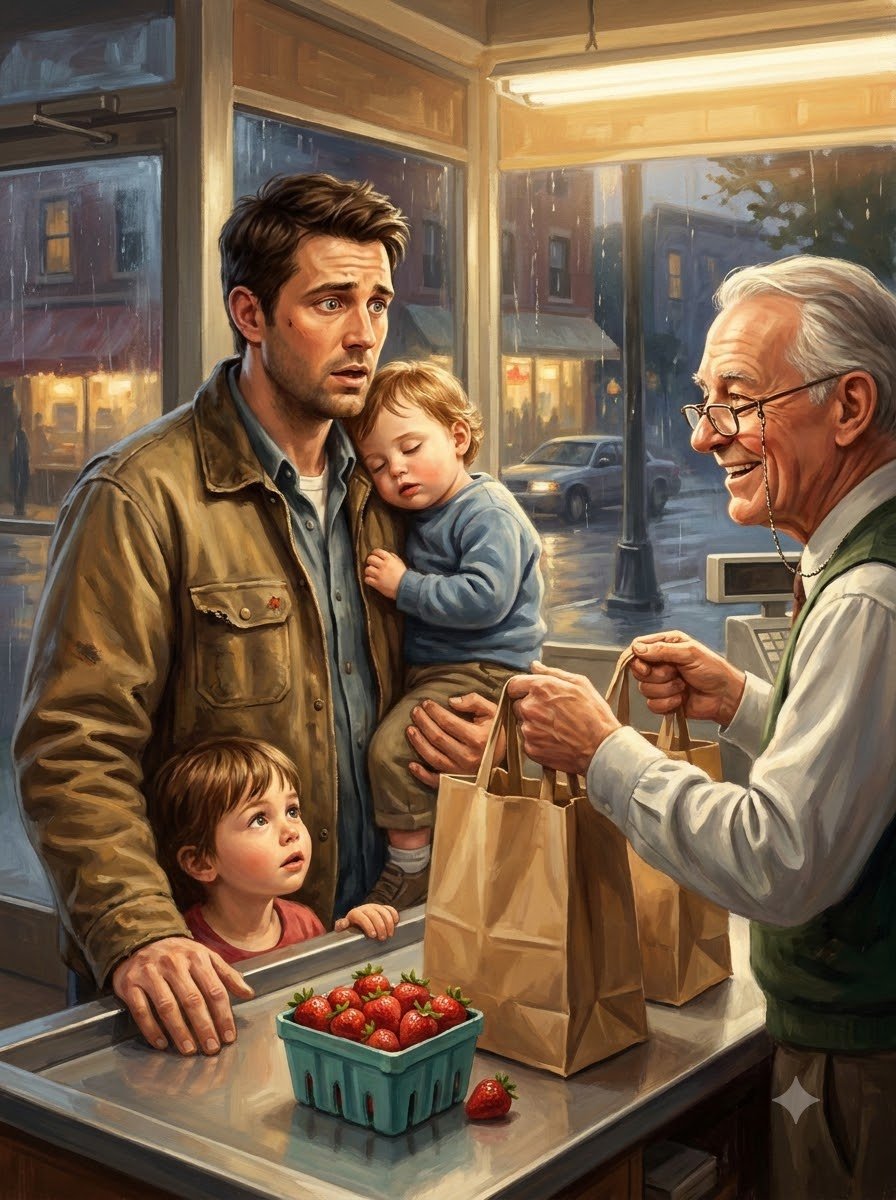
When single dad Marcus Bell lost his factory job, he started putting groceries back at the register. Then one Thursday, the cashier told him his bill had already been paid. It happened again the next week, and every Thursday for a year. Nobody would tell him who it was. On the last Thursday, the cashier handed him an envelope. Read all 8 chapters below.
A Midnight Chapters original story. All characters and events are fictional.
Chapter 1: Putting Things Back
The first thing I put back was the coffee.
It was a Thursday in October, at Hartley’s Family Market on the south side of Toledo, Ohio. My kids were with me: Jada, who was nine and already doing math in her head faster than I could, and Malik, who was six and wanted every single cereal with a cartoon on the box.
I’d been laid off from the auto parts plant three weeks earlier. Eleven years on the line, and they’d let two hundred of us go in one afternoon, with a handshake and two weeks’ severance. My unemployment check hadn’t started yet. My ex-wife, Danielle, had moved to Atlanta two years ago and sent money when she remembered, which was not often.
I had forty-three dollars in my checking account and a list on the back of an envelope.
The total on the register screen said $61.18.
“Hang on,” I told the cashier, a tired-looking woman in her fifties with reading glasses on a chain and a name tag that said BARB. “Let me take a couple things off.”
I took off the coffee first. Then the ground beef. Then the strawberries Jada had picked out, which she watched me set aside without a word, her jaw tight, the way she’d been watching everything since her mother left. Too old for nine.
“Daddy,” Malik said, “why are you giving back the strawberries?”
“We’ll get them next time, buddy.”
$44.06. I dug in my coat pocket for change and came up with a dollar and six cents.
Barb looked at me over her glasses. She didn’t say anything. She just rang it up, bagged it, and slid the bags across the counter.
That night, after the kids were asleep, I sat at the kitchen table with my laptop and filled out nineteen job applications. Warehouse. Delivery. Night security. Anything.
I didn’t hear back from any of them that week.
Chapter 2: Already Taken Care Of
The next Thursday, I went back to Hartley’s with thirty-one dollars and a shorter list.
Milk. Bread. Eggs. Peanut butter. Rice. A bag of apples. A box of the cheapest cereal, the one without a cartoon, which Malik complained about all the way down aisle four.
I got in Barb’s line on purpose. I didn’t know why. I think I didn’t want to start over with a stranger who’d watch me put things back.
She scanned everything. The screen said $28.40.
I held out my debit card.
Barb didn’t take it. She was looking at a small slip of paper taped to the side of her register.
“You’re all set, hon,” she said.
“Sorry?”
“It’s been taken care of.” She started bagging my groceries.
“What do you mean, taken care of?”
“Somebody paid it.” She handed Malik a sticker from the roll under her counter. “Already taken care of.”
“Who?”
Barb shook her head. “Couldn’t tell you.”
“Couldn’t, or won’t?”
She looked at me over her reading glasses, the way you’d look at a kid who’d asked a very obvious question.
“Won’t,” she said. “Have a good week, Marcus.”
I hadn’t told her my name.
I stood there for a long time, holding my bags. Behind me, an old man with a cart full of canned soup cleared his throat. I mumbled an apology and walked out into the cold.
In the parking lot, Jada looked up at me. “Daddy, who paid for our food?”
“I don’t know, baby.”
“Is it bad?”
I thought about that.
“No,” I said finally. “I think somebody was just being kind.”
She considered this with her usual seriousness. Then she reached into a grocery bag, pulled out the bag of apples, and checked it carefully.
“Okay,” she said. “But next time, we’re getting strawberries.”
Chapter 3: Every Thursday
It happened again the next Thursday.
And the Thursday after that.
Every single week, I’d fill my cart, get in Barb’s line, and wait for the total, and every single week, she’d glance at the slip of paper taped to her register and say, “You’re all set, hon. Already taken care of.”
It didn’t matter what I bought. It didn’t matter if the total was twenty dollars or ninety. Whoever it was paid for all of it.
At first, I was grateful. Then I was embarrassed. Then I was angry. I’d worked since I was sixteen. I had never taken a handout in my life. And now some stranger was paying for my kids’ food like I was a charity case.
The fourth Thursday, I decided I was going to find out who.
I got to Hartley’s an hour early and sat in my car in the parking lot, watching the door. I thought maybe whoever it was came in before me and left money at the register.
Nobody suspicious went in. Just the usual Thursday crowd: retirees, young moms, a couple of construction workers grabbing lunch.
When I went in and got in Barb’s line, she took one look at my face and laughed.
“You’ve been sitting in that parking lot for an hour,” she said. “I saw you.”
“Barb, please. Who is it?”
“Can’t tell you.” She scanned a gallon of milk. “Made a promise.”
“Is it someone from my old job? From church?”
“Can’t tell you.”
“Is it you?”
Barb actually laughed out loud at that. “Hon, I make fourteen-fifty an hour. If it was me, you’d be eating ramen noodles.”
“Then just tell me why.”
She stopped scanning. She looked at me, really looked at me, for a long moment over her glasses.
“Because a long time ago,” she said quietly, “you did somebody a kindness and never stuck around to be thanked. And they’ve been waiting eleven years to pay it back.”
“I don’t know what you’re talking about.”
“I know you don’t,” Barb said, and handed Malik his sticker. “That’s the point.”
Chapter 4: The Year That Kept Going
The months went by. The Thursdays kept coming.
I got a job in December, working nights at a distribution warehouse out by the interstate, loading trucks. It paid less than the plant, but it paid. My neighbor, Mrs. Ruiz, watched the kids overnight in exchange for me fixing things around her house.
I went back to Hartley’s that first Thursday after my first paycheck, ready to finally pay for my own groceries.
“You’re all set, hon,” Barb said. “Already taken care of.”
“Barb, I have a job now. I can pay.”
“Not my call,” she said. “The arrangement’s for a year. Whoever it is said a year. So it’s a year.”
“Then can you at least give them a message?”
Barb hesitated. Then she pulled a pen out of her hair and slid a blank receipt across the counter.
I didn’t know what to write. I stood there for a long time while the line behind me grew.
Finally, I wrote: Thank you. My kids haven’t missed a meal since October. I don’t know who you are or why you’re doing this, but I’m going to spend the rest of my life trying to deserve it. —Marcus
Barb folded the receipt carefully and tucked it into her apron pocket.
The next Thursday, there was a new slip of paper taped to the register. Barb handed it to me with my bags.
It was written in shaky, old-fashioned cursive, the kind they used to teach in schools. Only five words.
You already did. Thank you.
I kept that slip of paper in my wallet. I still have it.
Things got better slowly, the way things do. I got promoted to shift supervisor at the warehouse in April. Jada won the district math competition in May. Malik learned to ride a bike. We bought strawberries every week.
And every Thursday, Barb said, “You’re all set, hon.”
Until the Thursday in October that marked one full year.
I walked up to Barb’s register with my cart. She didn’t scan anything. She reached under the counter and handed me a cream-colored envelope with my name on the front, in that same shaky cursive.
“This is the last one,” Barb said, and her eyes were wet. “She asked me to give you this.”
She.
Chapter 5: The Letter
I opened it in my car in the Hartley’s parking lot, with the engine running and the heater blasting, while the kids ate strawberries in the back seat.
Dear Marcus,
You don’t remember me. That’s all right. I didn’t expect you to.
Eleven years ago, on the night of the worst blizzard Toledo had seen in thirty years, my grandson Toby wandered away from me in the parking lot of Hartley’s Family Market. He was nine years old. He has autism, and he doesn’t speak very much, and he was terrified of the wind. I turned around to load my groceries into the trunk, and when I turned back, he was gone.
I searched for an hour. The police came. They couldn’t find him in the snow. I thought my grandson was going to freeze to death because of me.
Three hours later, a young man in a Hartley’s stock-boy uniform called the police from a bus shelter on Anthony Wayne Trail. He’d found Toby half a mile away, hiding under the bench, soaked through and shaking. He’d wrapped him in his own coat. He’d sat with him for three hours in the cold, singing him songs from the radio, because every time he tried to move him, Toby screamed. By the time the police arrived, Toby was asleep against his shoulder.
The young man waited until Toby was in my arms. Then he walked away into the snow before I could ask his name. He had a tattoo of a little gray bird on the inside of his left wrist. That’s all I knew about him for eleven years.
Last October, I was standing behind you in line at Barb’s register when you put back the strawberries. You rolled up your sleeve to dig in your pocket for change, and I saw the little gray bird.
I have thought about you every single day for eleven years, Marcus. I prayed for you. I never knew your name. And there you were, a grown man, a father, putting strawberries back on the counter so your children could have milk.
So I paid for your groceries. For a year. Barb helped me. She’s a dear friend from church. It was the least I could do for the man who gave me back my grandson.
I am eighty-three years old, and I’m afraid I’m quite ill now. I won’t be able to come to Hartley’s on Thursdays anymore. But if you’d like to meet me, and Toby, I would be very grateful.
Your friend,
Eleanor Voss
Underneath, she’d written an address in Ottawa Hills and a phone number.
I looked down at the inside of my left wrist. At the small gray sparrow I’d gotten tattooed when I was nineteen, the week after my mother died, because she used to call me her little bird.
I remembered the blizzard. Of course I remembered. I was twenty-five, working nights as a stock boy at Hartley’s while I tried to get on at the plant. I’d been walking to the bus stop after my shift when I heard a kid crying under the bench, and I’d sat with him for three hours in the snow because I didn’t know what else to do.
I’d never told anyone. It hadn’t seemed like a big deal.
In the back seat, Jada leaned forward. “Daddy? Why are you crying?”
“Because,” I said, wiping my face with the back of my hand, “it turns out I knew who it was all along.”
Chapter 6: Ottawa Hills
Eleanor Voss lived in a big, old brick house with green shutters on a quiet street lined with oak trees. I’d never been to Ottawa Hills before. It was the kind of neighborhood where people had gardeners.
I brought the kids. I didn’t know what else to do. Jada wore her nicest dress. Malik wore his Spider-Man shirt, which he considered his nicest shirt.
A tall, thin young man with dark hair and a careful, slightly stiff way of moving opened the door. He was about twenty. He didn’t make eye contact. He looked at a spot just past my left shoulder.
Then his eyes dropped to my left wrist, to the little gray bird.
He went very still.
“Bird man,” he said quietly.
I swallowed hard. “Hi, Toby.”
Toby didn’t say anything else. He just turned and walked down the hallway, and after a moment, I realized he wanted us to follow him.
Eleanor was in a hospital bed set up in the sunroom at the back of the house, surrounded by plants and windows and October light. She was tiny and frail, with snow-white hair and an oxygen tube under her nose. But when she saw me, her whole face lit up.
“Oh,” she breathed. “Oh, there you are.”
I didn’t know what to do. So I sat down in the chair beside her bed and took her hand. It was thin as paper.
“Thank you,” I said. “For the groceries. For all of it. I don’t even know how to—”
“Hush.” She squeezed my hand with surprising strength. “You don’t thank me. Not ever. I owed you a grandson.”
Toby had sat down in the corner, rocking slightly, watching us. Malik, who had no concept of personal space, walked right over to him.
“Do you like Spider-Man?” Malik asked.
Toby looked at Malik’s shirt for a long time.
“Venom is better,” he said.
Malik gasped, deeply offended, and the two of them launched into an argument about superheroes that lasted forty-five minutes.
Eleanor watched them, smiling.
“He doesn’t talk to people,” she whispered to me. “Hardly ever. He’s been waiting eleven years to see you again. He drew pictures of the bird on your wrist all through middle school.”
Chapter 7: The Only Thing She Asked
I visited Eleanor every Thursday after that.
It became our new routine. I’d go to work, sleep a few hours, pick up the kids from school, and drive to Ottawa Hills. Jada did her homework at the dining room table. Malik and Toby played video games and argued about superheroes. I sat with Eleanor in the sunroom while she told me about her life.
She’d been a schoolteacher for forty years. Her husband, Walt, had died fifteen years ago. Her only daughter, Toby’s mother, had struggled with addiction and lost custody when Toby was four. Eleanor had raised him herself.
“I worry about what happens to him,” she told me one Thursday in November, very quietly, while Toby was in the other room. “When I’m gone. He has a trust. My lawyer will handle the money. But money isn’t the same as somebody who shows up.”
“I’ll show up,” I said.
She looked at me for a long time.
“You don’t have to say that, Marcus.”
“I know I don’t.” I squeezed her hand. “I’m saying it anyway.”
She closed her eyes, and a tear slid down her cheek and into her white hair.
Eleanor died two weeks before Christmas, peacefully, in her sunroom, with Toby holding one of her hands and me holding the other.
At the funeral, Barb from Hartley’s sat in the second row, in a black dress, crying into a handkerchief. After the service, she found me in the church parking lot.
“She had me promise one more thing,” Barb said. She pressed a small envelope into my hand. “For after.”
Inside was a single index card in Eleanor’s shaky cursive.
Marcus, I have only one request. Not for me. For whoever’s standing behind you in line someday, putting the strawberries back.
—E.V.
Chapter 8: You’re All Set, Hon
A year later, I was a shift manager at the distribution center. I’d gotten a raise and moved the kids into a small house with a backyard. Toby lived in a group home for young adults with autism near the university, where he worked part-time in the library, shelving books with perfect, silent precision. Every Thursday, he came to our house for dinner.
Malik still thought Venom was the worst.
On a cold Thursday in October, two years after the first time I put back the strawberries, I was in Barb’s line at Hartley’s with a full cart. Ahead of me was a young woman, maybe twenty-two, with a baby on her hip and a toddler holding onto her coat. She looked exhausted. Her total came up on the screen: $73.12.
She looked at the screen. Then she quietly started taking things out of her bags.
Baby formula. Then diapers. Then a small carton of strawberries.
I knew that look. I knew exactly what it felt like.
I caught Barb’s eye over the woman’s shoulder.
Barb raised her eyebrows. I nodded.
Barb’s mouth twitched into a smile. She reached under the counter, pulled out a slip of paper, and taped it to the side of her register.
“Put those back in your bag, hon,” Barb told the young woman gently.
The woman looked up, confused. “I’m sorry, I don’t have—”
“You’re all set,” Barb said. “Already taken care of.”
“What? By who?”
“Couldn’t tell you.”
“Couldn’t,” the young woman said, her voice shaking, “or won’t?”
Barb looked at her over her reading glasses. Then she glanced at me, just for a second, and winked.
“Won’t,” she said. “Have a good week, sweetheart.”
The young woman put the strawberries back in her bag, her eyes filling with tears, and walked out into the cold with her children.
I stepped up to the register and handed Barb my debit card.
“Same arrangement?” Barb asked. “A year?”
“A year,” I said. “Every Thursday.”
Barb rang up my groceries, then hers, and handed me the receipt.
“She’d be proud of you, you know,” Barb said quietly.
I looked down at the little gray bird on the inside of my wrist.
“She’d say I owed her,” I said. “And she’d be right.”
Outside, the first snow of the season was starting to fall, soft and slow over the parking lot. My kids were waiting in the car, arguing about something, probably Spider-Man.
On the passenger seat sat a carton of strawberries.
The End.
Midnight Chapters publishes original fiction. All names, characters, businesses, and events in this story are imaginary. Any resemblance to real persons or events is coincidental.