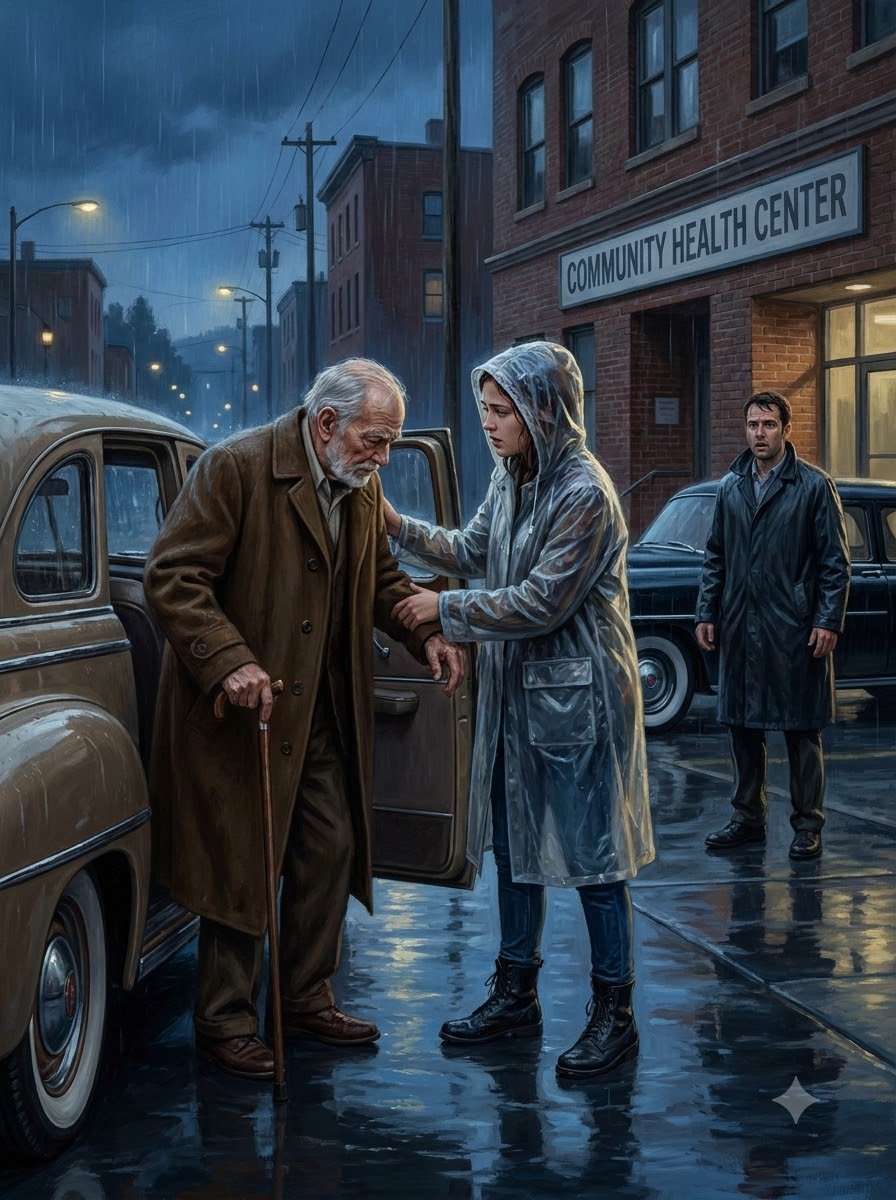
Tessa Morgan was the best analyst on her team, but she was forty minutes late every Monday, and the strict new CEO fired her in front of the whole office for it. She never explained. So the next Monday, at six in the morning, he followed her car — and ended up in a place that would force him to face what his own family had done. Read all 8 chapters below.
A Midnight Chapters original story. All characters and events are fictional.
Chapter 1: Forty Minutes Late
I slipped into the conference room at 9:41 a.m., my hair still damp from the rain, and every head at the long glass table turned toward me.
Including his.
Julian Calloway had been CEO of Calloway Industries for exactly three weeks. He was thirty-five, the son of the man who had run the company for thirty years, and he had arrived in Pittsburgh from the company’s New York office with a reputation for being brilliant, cold, and completely allergic to excuses.
On his first day, he had sent a company-wide email titled Standards. Point three said: Punctuality is respect. Repeated lateness without explanation will not be tolerated.
This was my third Monday late since he’d arrived.
“Ms. Morgan,” he said, without looking up from his tablet. “Nice of you to join us.”
“I’m sorry,” I said, sliding into an empty chair at the end of the table. “It won’t—”
“Happen again?” He finally looked up. His eyes were dark gray, and they didn’t blink. “According to the badge records, it’s happened every Monday for the past eleven months. You arrive between 9:35 and 9:45. Every other day of the week, you’re at your desk by 8:30.”
The room had gone very quiet. Dev Patel, who sat next to me, stared at the table like it had suddenly become fascinating.
“I make up the time,” I said quietly. “I stay late on Mondays. Until seven, usually. You can check that in the badge records too.”
“That’s not the point.” Julian set down his tablet. “The point is that this team meets at nine on Mondays, and you’ve missed the first forty minutes of every single one. Your manager says you’ve never given a reason. HR says you’ve never asked for a schedule accommodation.” He paused. “So I’m going to ask you once, in front of the team you keep letting down. Why?”
I thought about Mr. Odell, sitting in the passenger seat of my old Honda at 5:45 that morning, his hands shaking on his cane, saying, Promise me you won’t tell those folks at your work, Tessa. A man’s got to keep some dignity.
I looked down at the table.
“It’s personal,” I said.
Julian studied me for a long moment.
“Then I’m sorry,” he said. “But I’m not running a company where personal comes before the people counting on you. Please see HR after this meeting. Today will be your last day at Calloway Industries.”
Someone gasped. Dev made a small, strangled sound.
I stood up. My legs were shaking, but my voice wasn’t.
“Yes, sir,” I said.
And I walked out of the conference room without looking back.
Chapter 2: The Box on My Desk
HR gave me a cardboard box and an hour to clear my desk.
I’d worked at Calloway Industries for four years, since I was twenty-four. I’d started as a temp entering invoices and worked my way up to senior data analyst. I’d built the forecasting model the sales team used every quarter. Last year, I’d found a billing error that saved the company almost two million dollars. My manager, Linda, had cried when she gave me my performance review.
Now Linda stood next to my desk, red-eyed, watching me pack a coffee mug, a cactus, and a framed photo of my parents.
“I tried to tell him,” she whispered. “I told him you’re the best analyst we have. He said that just makes it worse. That if the best people don’t follow the rules, nobody will.”
“It’s okay, Linda.”
“It’s not okay. Tessa, if you’d just tell him why—”
“I can’t,” I said. “It’s not my secret to tell.”
Dev walked me to the elevator, carrying the box. “This is insane,” he kept muttering. “He’s a robot. A robot in a five-thousand-dollar suit.”
“He’s not wrong, exactly,” I said tiredly. “I was late. I wouldn’t explain. If I were him, I’d probably think I was lazy too.”
“You’re the least lazy person I’ve ever met.”
The elevator doors opened. Dev handed me the box and hugged me awkwardly around it.
“Whatever it is,” he said, “I hope it’s worth it.”
I drove home through the gray Pittsburgh drizzle and parked outside my apartment building in Bloomfield, a tired brick walk-up with a broken buzzer and a landlord who never answered the phone.
Mr. Odell was sitting on the front stoop under the overhang, his cane across his knees, wrapped in the brown wool coat he’d owned since before I was born. He was seventy-eight, a retired steelworker with hands like baseball mitts and a voice like gravel. He lived in the apartment across the hall from mine. His wife, Loretta, had died three years ago.
He saw the cardboard box in my arms, and his face fell.
“Tessa,” he said. “What happened?”
“Nothing,” I lied. “I’m just taking some things home.”
He looked at the box. At the cactus. At the framed photo.
“They fired you,” he said quietly. “Because of me.”
“No. Because of me. I’m the one who wouldn’t explain.”
He put his face in his big, scarred hands.
“Three times a week, they hook me up to that machine,” he said, his voice muffled. “Monday, Wednesday, Friday. Four hours each time, so my blood gets cleaned because my kidneys won’t do it anymore. And now it’s costing you your whole job.” He looked up, and his eyes were wet. “I’ll take the bus. I should’ve been taking the bus all along.”
“Mr. Odell, the bus doesn’t run before seven on Mondays, and you’d have to switch twice with your legs the way they are.” I sat down next to him on the cold stone step. “It’s done. I’ll find another job. I always do.”
He shook his head slowly.
“Loretta would be so ashamed of me,” he said.
“Loretta,” I said, “would’ve driven you herself.”
Chapter 3: The Car Behind Me
The next Monday, I woke up at 5:15 a.m. out of habit.
I didn’t have a job to rush to anymore. But Mr. Odell had dialysis at 6:00, the same as every Monday, and the medical van company that used to pick him up had cut its early-morning Monday route eleven months ago to save money.
That was why I’d been late every Monday for eleven months.
I’d drive him to the dialysis center in Lawrenceville, help him inside, wait until he was settled in his chair and hooked up to the machine, and make sure the nurses knew he hadn’t eaten breakfast because he’d been too nervous. Then I’d drive across the river to work. On Wednesdays and Fridays, his neighbor’s grandson took him. But on Mondays, it was just me.
At 5:48, I helped him into the passenger seat of my Honda. He was quiet. He’d been quiet all week.
“You don’t have to do this anymore,” he said. “You don’t have a job to get to.”
“Then I’ve got all the time in the world,” I said, and pulled out onto the empty street.
It was still dark. The streetlights reflected off the wet pavement. There was almost no traffic.
Which is why I noticed the car behind us.
It was a black Tesla. It had pulled out from the curb about half a block after I did, and it had followed us through four turns. When I slowed down, it slowed down. When I changed lanes on Butler Street, it changed lanes too.
“Mr. Odell,” I said quietly, “don’t turn around. But I think someone’s following us.”
He turned around immediately. “Black car,” he said. “Fancy. Can’t see the driver.”
My heart started pounding. I thought about calling the police. Then I thought about how much it would cost Mr. Odell to miss even one dialysis session, and I kept driving.
I pulled into the lot of the Allegheny Kidney Care Center at 6:01. The Tesla pulled in three spaces away.
I helped Mr. Odell out of the car and onto his cane. The driver’s door of the Tesla opened.
Julian Calloway stepped out into the drizzle. No suit, this time. Jeans, a dark sweater, a rumpled raincoat. He looked like he hadn’t slept.
He looked at me. Then he looked at Mr. Odell, at the cane, at the sign over the door.
ALLEGHENY KIDNEY CARE · DIALYSIS SERVICES.
I watched every bit of color drain from his face.
“Ms. Morgan,” he said hoarsely. “I’m— I needed to understand. I’ve read your file a dozen times this week. It didn’t make any sense.” He swallowed. “I’m so sorry. I had no idea.”
“No,” I said, more coldly than I meant to. “You didn’t. Because you didn’t ask the right question. You asked why I was late. You never asked if I was okay.”
Mr. Odell squinted at him through the rain.
“Calloway,” he said slowly. “Did she say Calloway?”
Chapter 4: Mr. Odell’s Monday
Julian walked inside with us. I don’t know why I let him.
The dialysis center was bright, quiet, and smelled like antiseptic. A dozen patients sat in big reclining chairs along the walls, tubes running from their arms to the humming machines beside them. The nurses knew Mr. Odell by name. One of them, a cheerful woman named Ada, hugged him and scolded him for not eating breakfast, the way she did every Monday.
When he was settled in his chair, with the needles in and the machine whirring, Mr. Odell looked up at Julian, who was standing awkwardly by the window like he didn’t know where to put his hands.
“Pull up a chair, son,” Mr. Odell said. “You might as well. I’m here for four hours.”
Julian sat.
“You’re Robert Calloway’s boy,” Mr. Odell said. It wasn’t a question.
“Yes, sir.”
Mr. Odell nodded slowly. “I figured. You’ve got his chin.”
“You know my father?”
“I worked for him.” Mr. Odell’s voice was quiet and very even. “Thirty-one years at the Calloway Steel Fabrication plant in Homestead. Started on the floor at nineteen, right out of the Army. Ended up running the night shift. Lost the tip of this finger in a press in 1981.” He held up his left hand, showing the stub of his index finger. “Your granddaddy sent me flowers in the hospital.”
Julian didn’t say anything. He just listened.
“Plant closed in 2009,” Mr. Odell went on. “Your daddy moved the work to Mexico. Six hundred people lost their jobs in one afternoon. He came down to the floor himself and shook every one of our hands. Told us not to worry. Said Calloway always takes care of its own. Said our pensions were safe.”
“And?” Julian asked quietly.
“Two years later, a letter came. The pension fund had been ‘restructured.’ We’d all get forty cents on the dollar.” Mr. Odell looked at the machine, at his own blood moving through the tubes. “Loretta and I had planned to retire to a little place in Florida. Instead, we stayed in that apartment in Bloomfield. When her heart got bad, we couldn’t afford the specialist. When my kidneys went, I couldn’t afford the private car service. So Tessa here started driving me.”
Julian turned and looked at me. “Is that true?”
“I didn’t know about the pension,” I said. “He never told me where he used to work. If I’d known it was Calloway, I—” I stopped.
“You’d have what?” Julian asked.
“I’d have quit a long time ago,” I said.
Julian flinched as if I’d slapped him.
Mr. Odell reached out with his free hand and patted Julian’s knee, gently, the way you’d comfort a kid who’d fallen off his bike.
“It’s not your fault, son,” he said. “You were a boy when all that happened. I’m not angry at you.” He leaned his head back against the chair and closed his eyes. “I’m just tired. That’s all. Seventy-eight years of being tired.”
Julian sat there for all four hours.
He didn’t check his phone once.
Chapter 5: What Julian Found in the Archives
Julian called me on Wednesday night.
“I need to show you something,” he said. “And I need your help. Professionally. I’ll pay you a consulting rate. Whatever you want.”
“I don’t want your money, Mr. Calloway.”
“Julian,” he said. “Please. And it’s not for me. It’s for him.”
I met him at Calloway Industries at nine o’clock that night. The building was dark and empty. He led me to a small conference room on the fourteenth floor, where every surface was covered in old banker’s boxes, yellowed ledgers, and printouts.
“Archives,” he said, rubbing his eyes. “I’ve been down in the basement since Monday afternoon.”
I picked up a file. It was labeled Calloway Steel Fabrication Pension Trust, 2008–2012.
“My father always told me the pension fund failed because of the 2008 financial crisis,” Julian said. “Bad investments. Market crash. Nobody’s fault.” He shook his head. “That’s not what happened.”
He spread out a set of financial statements on the table.
I am a data analyst. I read numbers the way some people read novels. It took me less than ten minutes to see it.
In 2009, as the plant was closing, the pension trust had been “rebalanced.” Forty-three million dollars had been moved out of conservative bonds and into a private real estate fund. A real estate fund that, I saw when I flipped to the next page, was partly owned by a Calloway family holding company.
The fund collapsed two years later. The pension trust lost most of its value. The workers lost sixty percent of their retirement.
The Calloway family holding company had sold its stake in the real estate fund six months before the collapse. At a profit.
I put the papers down.
“Was this legal?” I asked quietly.
“Barely,” Julian said. “The lawyers made sure of that. It was disclosed in a footnote on page forty of an annual report nobody read.” He sat down heavily. “It was legal. It was also the most disgusting thing I’ve ever seen.”
“Did your father know?”
Julian was quiet for a long time.
“He signed it,” he said finally. “His signature is on every page.”
I looked at him. He looked exhausted. Older than thirty-five.
“Two hundred and fourteen retirees are still alive,” he said. “I checked. Mr. Odell is one of them. Some of them are worse off than he is. One man in Munhall is living in his car.” He looked up at me. “I want to fix it. I want to restore their pensions in full, with back payments. But I need the board to approve it, and the board is made up of people my father put there. I need numbers they can’t argue with. I need someone who can build a model in a week that would normally take three months.”
“You fired me,” I reminded him.
“I know,” he said. “It was the worst decision I’ve made in my life. I’m asking you anyway.”
I looked at the boxes. At the files. At the signature at the bottom of the page.
Then I took off my coat and sat down.
“Get me coffee,” I said. “A lot of coffee.”
Chapter 6: The Board Meeting
We worked every night for nine days.
I built the model on my old laptop at his conference table, from nine p.m. until two or three in the morning. Julian brought coffee and takeout and read every page of every file twice. He was smarter than I’d expected, and much less cold. He asked good questions. He admitted when he didn’t understand something. He laughed, once, at a terrible joke I made about spreadsheets, and it changed his whole face.
By the second week, I’d stopped thinking of him as the man who fired me.
The model showed that fully restoring the pensions of all 214 retirees, with back payments and interest, would cost Calloway Industries about thirty-eight million dollars over ten years. It sounded like a lot. But Calloway’s annual profit was over three hundred million. Spread over a decade, it was less than two percent of profits.
“They’ll say it’s not legally required,” I told Julian the night before the board meeting. “They’ll say it sets a dangerous precedent.”
“Then we’ll tell them what it costs if we don’t,” Julian said.
The board of Calloway Industries met in a wood-paneled room on the top floor with a view of the three rivers. Eleven men and two women sat around a long mahogany table. At the head sat Robert Calloway, Julian’s father, the founder’s son, now seventy and still chairman of the board. He had silver hair, a golf tan, and the same gray eyes as his son.
Julian presented the facts. I presented the numbers.
When I finished, nobody spoke for a while. Then a board member named Harrison, who had been friends with Robert for forty years, leaned back in his chair.
“This is all very moving,” he said. “But it’s ancient history. The fund lost money in a bad market. It happens. We don’t owe these people anything legally, and if we start writing checks every time someone has a sad story, we’ll have every former employee in Pennsylvania lining up.”
“It wasn’t a bad market,” Julian said. “It was a decision. My family’s decision. We moved their retirement into a fund we partly owned, sold our share before it collapsed, and let them take the loss.”
The room went very still.
Robert Calloway hadn’t said a word. He was staring at the papers in front of him, at his own signature, thirty years younger.
“Julian,” he said finally, his voice low. “That’s enough. You’re embarrassing this family.”
“No, Dad,” Julian said quietly. “This family embarrassed itself fifteen years ago. I’m just the first one willing to say it out loud.”
They took a vote.
Six in favor. Six against.
Every head turned to the chairman.
Robert Calloway stood up slowly, without casting his vote, and walked out of the room.
Chapter 7: Monday at Six A.M.
The vote was tabled for one week.
On Monday morning, at 5:48 a.m., I helped Mr. Odell into my Honda for his dialysis appointment. It was cold and dark and drizzling, the way it always seemed to be on Mondays.
When we pulled into the parking lot of the Allegheny Kidney Care Center, there were two cars already waiting.
One was Julian’s black Tesla.
The other was a long silver Mercedes with tinted windows.
Julian got out of the Tesla. He came over and helped me get Mr. Odell onto his cane. He looked nervous.
“I asked him to come,” he said quietly. “I didn’t think he would.”
The back door of the Mercedes opened. Robert Calloway stepped out in a camel-hair coat, looking older than he had in the boardroom, and much less sure of himself.
He walked toward us across the wet parking lot. He stopped a few feet away from Mr. Odell.
For a long moment, neither of them said anything.
Then Mr. Odell squinted up at him through the rain.
“Bobby Calloway,” he said. “You got old.”
Robert Calloway’s face did something complicated.
“Frank Odell,” he said slowly. “Night shift. You were the one who pulled Eddie Russo out of the furnace room in ’94 when the line burst.”
“Somebody had to,” Mr. Odell said.
“I remember.” Robert Calloway’s voice was rough. “I gave you a plaque.”
“I’ve still got it,” Mr. Odell said. “It’s on my wall. Next to Loretta’s picture.”
Robert Calloway looked at the dialysis center. At the cane. At the old brown wool coat.
“Julian tells me you’ve been coming here three times a week,” he said. “And that this young woman has been driving you on Mondays for almost a year.”
“That’s right.”
“Because the pension wasn’t enough to pay for a car service.”
“That’s right.”
Robert Calloway stood in the rain for a long time without speaking.
“Can I sit with you?” he asked finally. “While you have your treatment?”
Mr. Odell studied him. Then he shrugged.
“Ada makes terrible coffee,” he said. “But you’re welcome to it.”
Robert Calloway sat with Frank Odell for four hours that Monday. I don’t know what they talked about. Julian and I sat in the waiting room, drinking Ada’s terrible coffee, not saying much, our shoulders almost touching.
When Robert came out, his eyes were red.
He walked straight past us, took out his phone, and made a call.
“Harrison,” he said. “Call an emergency meeting of the board. Tomorrow morning. I’m voting yes.”
Chapter 8: The Monday Rule
The pension restoration passed eight to five.
All 214 retirees received a letter in the mail the following month. It came with a check for their back payments, a promise of full monthly pensions for life, and a handwritten note from Robert Calloway that said simply: We should have taken care of you. We are sorry. —R.C.
Mr. Odell framed his note and hung it on the wall next to his plaque and Loretta’s picture.
With his back pay, he could finally afford a private car service to dialysis. But on Mondays, he still rides with me. He says the car service drivers don’t laugh at his jokes.
Julian offered me my job back. I said no.
Then he offered me a new one: Director of Analytics, reporting directly to him, with a raise that made me sit down. And one condition, which he wrote into the official company policy himself.
He called it the Monday Rule.
Any Calloway employee who is caring for a sick family member, neighbor, or friend may request a flexible schedule, no questions asked, no explanation required. Kindness is not an excuse. It is a reason.
In the first month, forty-one employees used it. Dev used it to drive his grandmother to chemotherapy. Linda used it to take her son to physical therapy. Nobody had to stand up in a conference room and explain why.
The company also launched something called Calloway Rides: a free transportation service for any former Calloway employee who needs to get to a medical appointment. Mr. Odell is officially the program’s first passenger, though he still refuses to use it on Mondays.
I accepted the job.
On my first Monday back, I walked into the conference room at 9:41 a.m., my hair still damp from the rain.
Every head turned toward me. Including his.
Julian looked up from the head of the table and smiled.
“Ms. Morgan,” he said. “How’s Frank?”
“His numbers look good this week,” I said. “He says hi. And he says Ada’s coffee is getting worse.”
The whole room laughed. I sat down in the empty chair beside Dev, who grinned at me and slid over a cup of coffee he’d saved.
After the meeting, Julian caught me in the hallway.
“Tessa,” he said. He looked nervous, which was a new look on him. “I was wondering if you’d like to have dinner with me. Not as your boss. Just as a person who owes you a much better first impression.”
I pretended to think about it.
“What night?” I asked.
He smiled.
“Monday,” he said. “Any Monday you want.”
The End.
Midnight Chapters publishes original fiction. All names, characters, businesses, and events in this story are imaginary. Any resemblance to real persons, companies, or events is coincidental.