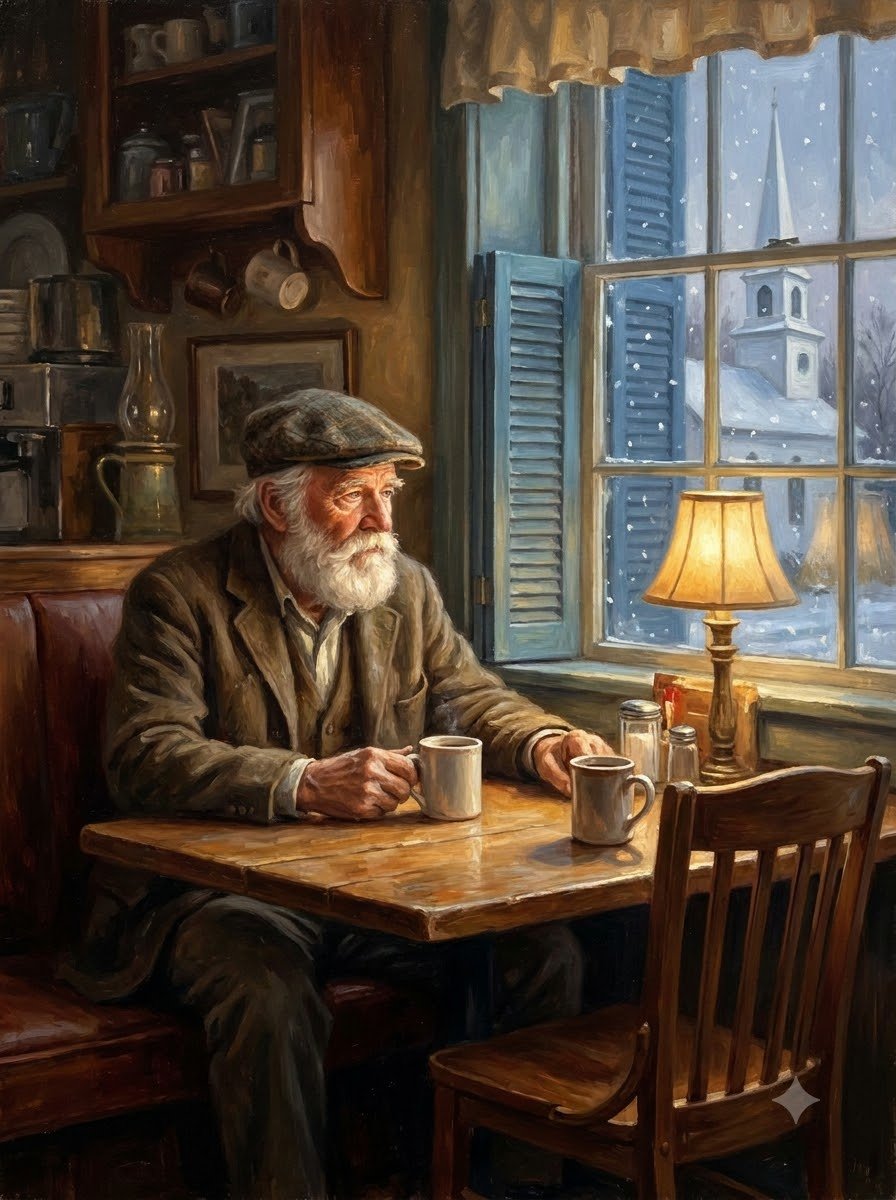
When Nora Quinlan inherited her aunt’s struggling café in a small Vermont town, she also inherited its strangest regular: an 84-year-old man who came in every night at seven, ordered two coffees, and never touched the second one. Nobody knew why. Then he missed a night, and Nora found what her aunt had locked away forty years ago. Read all 8 chapters below.
A Midnight Chapters original story. All characters and events are fictional.
Chapter 1: Two Coffees at Seven
The bell over the door rang at exactly 7:00 p.m., the way it had every night since I’d taken over the Bluebird Café.
“Evening, Mr. Brandt,” I said.
“Evening, Nora.”
Elias Brandt was eighty-four years old, tall and stooped, with a neatly trimmed white beard and a tweed cap he took off the moment he stepped inside. He walked with a cane carved from dark maple. He’d been a high school history teacher in Ashford Falls for thirty-eight years, and half the town still called him Mr. Brandt, including people in their sixties.
He hung his cap on the brass hook by the door and walked to the corner booth by the front window. Always the same booth. The one with the view of the town green and the white church steeple.
I didn’t have to ask what he wanted. Nobody did.
Two coffees. One black. One with cream and two sugars.
I set them down in front of him. He wrapped his hands around the black one and slid the other across the table, to the empty seat opposite him. He turned the handle of the second cup so it faced the empty seat, as if someone right-handed would be reaching for it.
Then he drank his coffee slowly and looked out the window at the green.
At 7:45, he stood, left a ten-dollar bill under the saucer, put on his cap, and nodded to me.
“Goodnight, Nora.”
“Goodnight, Mr. Brandt.”
The second coffee sat untouched and cold on the table. It always did.
“Every night,” said Darlene, who’d worked the counter at the Bluebird for twenty-six years. She was wiping down the pastry case and watching him go. “Every single night since 1985. Snowstorms. Fourth of July. The night his wife was buried.”
“His wife?”
“Helen. Lovely woman. Died eight years ago.” Darlene shook her head. “He was married to her for thirty-one years, and he still came in every night and ordered two coffees. She knew about it. Everybody knew about it. Nobody ever asked him why.”
“Didn’t my aunt ever ask?”
Darlene’s rag stopped moving.
“Your Aunt Ruth,” she said carefully, “made those two coffees herself every night for forty years. She wouldn’t let anyone else do it. And when Mr. Brandt left, she’d stand at that booth and look at the full cup for a long time before she poured it out.” She went back to wiping. “So, no. I don’t think she ever asked. I think she already knew.”
Chapter 2: The Café I Never Wanted
I hadn’t wanted the Bluebird Café.
I was thirty-three. Six months earlier, I’d been a marketing manager at a software company in Boston, with an apartment I could barely afford and a boyfriend who had just told me he “wasn’t ready for anything permanent,” three days after I’d found an engagement ring he’d bought for someone else.
Then my Aunt Ruth died of a stroke at seventy-nine, and her lawyer called to tell me she’d left me everything. The café, the apartment above it, and forty-one thousand dollars in debt.
I barely knew her. She was my father’s older sister, and she’d never married. She sent me birthday cards every year with a twenty-dollar bill and a short, formal note. When I was nine, my parents brought me to Ashford Falls for one summer week, and I remembered the Bluebird as a magical place full of pie and maple-sugar cookies and a stern, silver-haired woman who let me sit on the counter and lick frosting off a spoon.
I’d planned to come up for a month, sell the café, pay the debt, and go back to Boston.
That was six months ago.
The Bluebird was a small, crooked building on Main Street with blue shutters and a hand-painted sign. Inside there were eight booths, a long counter with red stools, a pastry case, and walls covered in photographs of Ashford Falls going back a hundred years. It wasn’t fancy. It wasn’t efficient. The espresso machine was older than me and screamed like a teakettle.
But every morning at six, the same dozen people came in for coffee and conversation. Farmers in muddy boots. Retired teachers. The volunteer fire chief. A young mother with twins in a double stroller who said the Bluebird was the only place in town where nobody minded if her kids cried. They knew each other’s names, illnesses, grandchildren, and opinions about the town budget.
I’d fallen in love with it, slowly, against my will.
The problem was that a developer named Craig Halvorsen had offered me three hundred thousand dollars for the building. He wanted to tear it down and put up a chain coffee shop with a drive-through. The offer was good for thirty more days.
Three hundred thousand dollars would pay off Aunt Ruth’s debt and give me a fresh start anywhere I wanted.
I hadn’t decided yet.
That night, after Mr. Brandt left, I sat down in his corner booth across from the cold, untouched coffee.
“Who are you waiting for?” I asked the empty seat.
The next evening, when he came in, I set down the two coffees and took a breath.
“Mr. Brandt,” I said, “I hope this isn’t rude. But who’s the second cup for?”
He looked up at me for a long moment. His eyes were pale blue and very kind.
“Someone who’s running a little late,” he said.
Then he smiled, wrapped his hands around his coffee, and looked out the window.
Chapter 3: The Night He Didn’t Come
The bell over the door didn’t ring at 7:00 on Thursday.
At 7:05, Darlene stopped what she was doing and looked at the clock.
At 7:15, she put her hand over her mouth.
“Forty years,” she said. “He’s never once missed. Not once.”
I called the police non-emergency line, then the Ashford Falls Volunteer Fire Department. The fire chief, who came in every morning for a cranberry muffin, said he’d send someone to check.
They found Mr. Brandt on the floor of his kitchen. He’d had a heart attack while making dinner. He was alive, barely, and they took him by ambulance to the hospital in Burlington.
The next afternoon, I closed the café early and drove up to see him. I didn’t really know why. I just knew that someone should, and he didn’t have any children, and Helen was gone.
He was in a room on the cardiac floor, hooked up to monitors, looking smaller and paler than I’d ever seen him. But when I knocked on the door frame, his face lit up.
“Nora,” he said. “You brought the Bluebird with you.”
I’d brought a cranberry muffin and a thermos of coffee. Black.
“The nurses will kill me,” he said happily, and drank half of it.
We talked for an hour. About the café. About Boston. About my aunt. And finally, because he was tired and the room was quiet and the monitors were beeping softly, I asked again.
“Who’s the second coffee for, Mr. Brandt?”
He was quiet for a long time. Then he said, “Her name was Margaret Ellison.”
He told me the story with his eyes closed.
In the summer of 1984, he was forty-two and teaching history at Ashford Falls High. Margaret was thirty-eight, a new art teacher with paint permanently under her fingernails and a laugh you could hear from the other end of the school. Every night after work, they’d meet at the Bluebird for coffee. Black for him. Cream and two sugars for her. They talked for hours. About books, about the war he’d come home from, about the paintings she wanted to make someday.
“I was in love with her by October,” he said. “I was too much of a coward to say so until June.”
But in June 1985, Margaret was offered a job at an art museum in Boston. Her dream job. She asked him to come with her. He refused. His mother was sick. He couldn’t leave. They fought, there in the corner booth, the night before she left.
“She said, ‘Elias Brandt, you will regret this for the rest of your life,'” he said softly. “And I said, ‘Then I’ll keep your coffee ready every night until you come back and tell me I told you so.'”
He opened his eyes.
“I wrote to her every week for a year,” he said. “Fifty-two letters. I never got a single answer. Then I heard she’d married someone in Boston. So I married Helen, who was a good, patient woman who knew exactly what that second cup meant and loved me anyway.” He swallowed. “But I made a promise. And a promise is a promise.”
I sat there with tears running down my face.
“Did you mail the letters from the post office?” I asked, almost without thinking.
“No,” he said. “I didn’t want the whole town knowing my business. So I left them with your aunt at the café. Ruth said she’d put them in the mail for me, along with the café’s outgoing mail.”
He smiled weakly.
“She was a good friend to me, your Aunt Ruth,” he said. “The best friend I ever had.”
Chapter 4: The Safe Behind the Flour Bins
I couldn’t sleep that night.
At two in the morning, I went downstairs into the dark café in my bathrobe and turned on the lights in the kitchen.
I’d found the safe in my first week, an old cast-iron box built into the wall behind the flour bins in the pantry. I’d assumed it held old receipts or Aunt Ruth’s jewelry, and I didn’t know the combination, so I’d never opened it.
Now I sat on an overturned flour bucket and stared at it.
Aunt Ruth’s handwritten recipe book was on the shelf above the stove, a fat binder stuffed with index cards and newspaper clippings. I’d been using it every day since I arrived. I pulled it down and flipped through it slowly.
The cranberry muffin recipe. Maple-sugar cookies. Blueberry pie.
On the very last page, tucked into a plastic sleeve, was a card I’d never noticed. It was a recipe for “Elias’s Coffee.” Black, medium roast, one heaping scoop per cup.
At the bottom, in small numbers, someone had written: 14 – 6 – 85.
June 14, 1985.
The night Margaret Ellison left Ashford Falls.
My hands were shaking when I turned the dial. Fourteen. Six. Eighty-five.
The safe clicked open.
Inside were letters. Hundreds of them, tied into bundles with faded blue ribbon. I pulled the first bundle into my lap.
They were addressed to Miss Margaret Ellison at an apartment in Boston, in neat, slanted handwriting I’d seen on Mr. Brandt’s tabs every night for six months.
None of them had stamps. None of them had ever been mailed.
There were fifty-two.
And underneath them was a second bundle, tied with a different ribbon. These letters were addressed to Mr. Elias Brandt, c/o The Bluebird Café, Main Street, Ashford Falls, Vermont, in loopy, artistic handwriting.
They all had Boston postmarks from 1985 and 1986. Every single one was still sealed.
I counted them on the pantry floor at three in the morning, crying so hard I could barely see.
Margaret had written back. Thirty-one times.
At the very bottom of the safe was a leather-bound diary with my aunt’s initials stamped in gold on the cover. R.Q.
Chapter 5: Aunt Ruth’s Confession
I read the diary at the kitchen table until the sun came up.
My aunt’s handwriting was small and precise. The entries started in 1983 and went on, on and off, for forty years.
He came in again tonight with the new art teacher, Ruth wrote in September 1984. He laughed at something she said. I’ve known Elias Brandt since we were six years old. I don’t think I’ve ever made him laugh like that.
June 15, 1985. She’s gone. He gave me his first letter to her this afternoon and asked me to mail it. I put it in the safe instead. I don’t know why I did it. I told myself I’d mail it tomorrow.
July 1985. Seven letters now. And today, one came from her. I almost opened it. I didn’t. I put it in the safe with the others. I am a terrible person. I know I am. But if she’s gone, maybe someday he’ll finally look at me the way he looked at her.
December 1985. He never looked at me. He asked me today if the mail was getting lost. I lied to his face.
August 1986. He told me he’s going to marry Helen Pratt. He said he heard Margaret married someone in Boston. I don’t know if that’s true. I never read her letters. I never could. I just kept them. Every one of them is a stone on my chest.
The entries got shorter and further apart over the years. Then, in the last few pages, they started again.
He still comes every night at seven. I still make both cups myself. It’s the only penance I know how to do.
I tried to tell him a hundred times. I’m a coward. I lost my best friend’s happiness, and I lost him as a friend too, in a way, because I could never look him in the eye again.
The last entry was dated three weeks before Ruth died.
I’ve written a letter to my niece, Nora, and given it to my lawyer. She’s the only one in this family with a good enough heart to set this right. I’m sorry, Nora. I’m sorry, Elias. I’m sorry, Margaret, wherever you are.
My aunt’s lawyer had given me a sealed envelope with the will. I’d put it in a drawer upstairs, unopened, because I’d assumed it was more bad news about the debt.
I ran upstairs and tore it open.
Dear Nora,
The combination is in the recipe book. Please find Margaret Ellison. Please give Elias back the life I stole from him.
And please don’t sell the Bluebird. It was the only good thing I ever made.
Love, Aunt Ruth.
Chapter 6: Finding Margaret Ellison
It took me nine days.
I started with the address on her letters. The Boston apartment building had been torn down in the 1990s. I searched online for “Margaret Ellison Boston artist” and found dozens of women by that name, none the right age.
On the fourth day, Darlene remembered something.
“She married a man named Dunn,” Darlene said, frowning over the coffee urn. “Your aunt mentioned it once. Years ago. Said it like it tasted bad.”
On the seventh day, I found an obituary from 2019 for a Boston architect named Robert Dunn, survived by his wife of thirty-two years, the painter Margaret Ellison Dunn, and a daughter, Beth.
On the eighth day, I found Beth Dunn’s email address through her work website. She was a pediatric nurse in Portsmouth, New Hampshire. I wrote to her, explaining as much as I could without sounding like a lunatic.
She called me that night. Her voice was cautious.
“My mother is eighty,” she said. “She lives in an assisted living home in Portsmouth. She has early dementia. Good days and bad days.” A pause. “And she has talked about a man named Elias for as long as I can remember. My dad used to joke about him. Your mother’s ghost from Vermont. I thought he was a story. A first love she exaggerated.”
“He wasn’t a story,” I said. “He’s real. And he’s been waiting for her every night for forty years.”
On the ninth day, I drove to Portsmouth with the bundle of Elias’s letters on the passenger seat.
Margaret Ellison Dunn was sitting in a sunny common room by a window overlooking the harbor, a sketchbook open in her lap. She was small and fine-boned, with white hair cut in a sharp bob and a pair of bright red reading glasses. Her fingers were stained with charcoal.
Beth introduced us and then stepped back.
“Mrs. Dunn,” I said, sitting down next to her. “My name is Nora Quinlan. I’m from Ashford Falls, Vermont. I run the Bluebird Café.”
Margaret’s pencil stopped moving.
“The Bluebird,” she said slowly. “I haven’t heard that name in a very long time.”
“I brought you something.”
I untied the blue ribbon and handed her the first letter. The envelope said Miss Margaret Ellison in Elias’s handwriting. It was dated June 15, 1985.
She looked at it for a long time. Then she opened it with trembling fingers and read it.
When she was done, she took off her red glasses and pressed her hand against her mouth.
“He wrote,” she whispered. “He wrote to me. I waited every day for a year. I wrote to him over and over, and he never answered, and I thought…” Her voice broke. “I thought he’d forgotten me.”
“He never forgot you,” I said. “Not for one day.”
Chapter 7: Seven O’Clock
Mr. Brandt came home from the hospital on a Tuesday.
His doctors told him to rest. He ignored them. On Wednesday, at exactly 7:00 p.m., the bell over the door of the Bluebird Café rang.
“Evening, Nora,” he said, slowly hanging his tweed cap on the brass hook.
“Evening, Mr. Brandt.”
He walked to the corner booth, leaning heavily on his maple cane. He sat down in his usual place and looked out the window at the green.
I didn’t tell him that the seat across from him was empty for the last time.
I didn’t tell him that for the past hour, an eighty-year-old woman with a white bob and red glasses had been waiting in my aunt’s old apartment upstairs, with her daughter holding one hand and me holding the other, nervously asking me over and over if her hair looked all right.
I made the two coffees myself. One black. One with cream and two sugars.
I set them down on the table. He slid the second one across to the empty seat, the way he’d done for forty years, and turned its handle to face the right.
Then I looked toward the kitchen door, and nodded.
Beth wheeled her mother out slowly.
The café was full that night. Word had spread through Ashford Falls the way only real news can. Darlene was behind the counter, crying into a dish towel. The fire chief was there, and the young mother with twins, and half the retired teachers in town. Nobody said a word. The whole room held its breath.
Mr. Brandt didn’t see her at first. He was looking out the window.
Then he heard the wheels on the old wooden floor. He turned his head.
He stared at her.
Margaret stopped her chair beside the booth. She looked at him, and then down at the cup of coffee with cream and two sugars sitting in front of the empty seat, its handle turned just so.
She reached out and touched the cup with her charcoal-stained fingers.
“It’s cold, Elias,” she said softly.
His face broke. His hands were shaking so badly that his own cup rattled against the saucer.
“Maggie,” he whispered. “You came back.”
“You told me you’d keep it ready,” she said, tears running down her face. “Every night until I came back and told you so.”
“So tell me,” he said, his voice cracking. “Go on. I deserve it.”
Margaret smiled. Beth helped her slide from the wheelchair into the booth, and she sat down across from him, in the seat that had waited forty years.
“I told you so,” Margaret said.
Then she reached across the table and took his hand, and the whole café started crying at once.
I brought a fresh cup of coffee. Cream and two sugars. I set it down in front of her.
She drank every last drop.
Chapter 8: The Reserved Booth
They were married on the first Saturday of June, at the Bluebird Café.
Ashford Falls had never seen anything like it. The whole town came. We moved the tables out onto the green and strung lights between the maple trees. The volunteer firemen grilled hot dogs. The high school jazz band played old songs from the 1950s. Darlene baked a three-tier maple cake and cried so hard while frosting it that she had to start over twice.
Elias wore his best suit and his tweed cap. Margaret wore a pale blue dress she’d painted flowers on herself, by hand, sitting in my aunt’s old apartment above the café every afternoon for a month.
They said their vows in the corner booth, with the minister standing by the window and a crowd pressed against the glass outside.
“Forty years,” Elias said, holding both of her hands across the table. “I’m sorry I made you wait.”
“I’m sorry you had to drink so much coffee alone,” Margaret said, and everyone laughed.
Afterward, when the sun was going down over the steeple, Margaret found me behind the counter, washing cups.
“Your aunt,” she said quietly. “Elias told me about the letters. About what she did.”
I braced myself. “I’m so sorry.”
“Don’t be. You’re not her.” She was quiet for a moment, watching Elias through the window, laughing with the fire chief on the green. “I was angry for a while. Very angry. And then I thought about her standing in this café every night for forty years, making my coffee and pouring it out. I think she punished herself more than anyone else ever could have.” She squeezed my hand. “She left you to fix it. And you did. That counts for something.”
I didn’t sell the Bluebird.
I turned down Craig Halvorsen’s offer the week after the wedding. When word got out that the café was in debt, the town held a pancake breakfast fundraiser on the green, and then another, and then the volunteer fire department started a jar by the register. Margaret donated six of her paintings for a silent auction. Elias donated his entire collection of first-edition history books.
By the end of summer, Aunt Ruth’s debt was paid in full.
On Labor Day, I hung a small brass plaque on the wall above the corner booth.
RESERVED · 7:00 P.M. · SINCE 1985
Every night at seven, the bell over the door still rings. Elias and Margaret come in together now, slowly, him with his maple cane and her with her charcoal-stained fingers wrapped around his arm. They sit in the corner booth by the window, looking out at the town green.
I don’t have to ask what they want. Nobody does.
Two coffees. One black. One with cream and two sugars.
And at 7:45, when they stand to leave, there are two empty cups on the table.
The End.
Midnight Chapters publishes original fiction. All names, characters, places, and events in this story are imaginary. Any resemblance to real persons or events is coincidental.