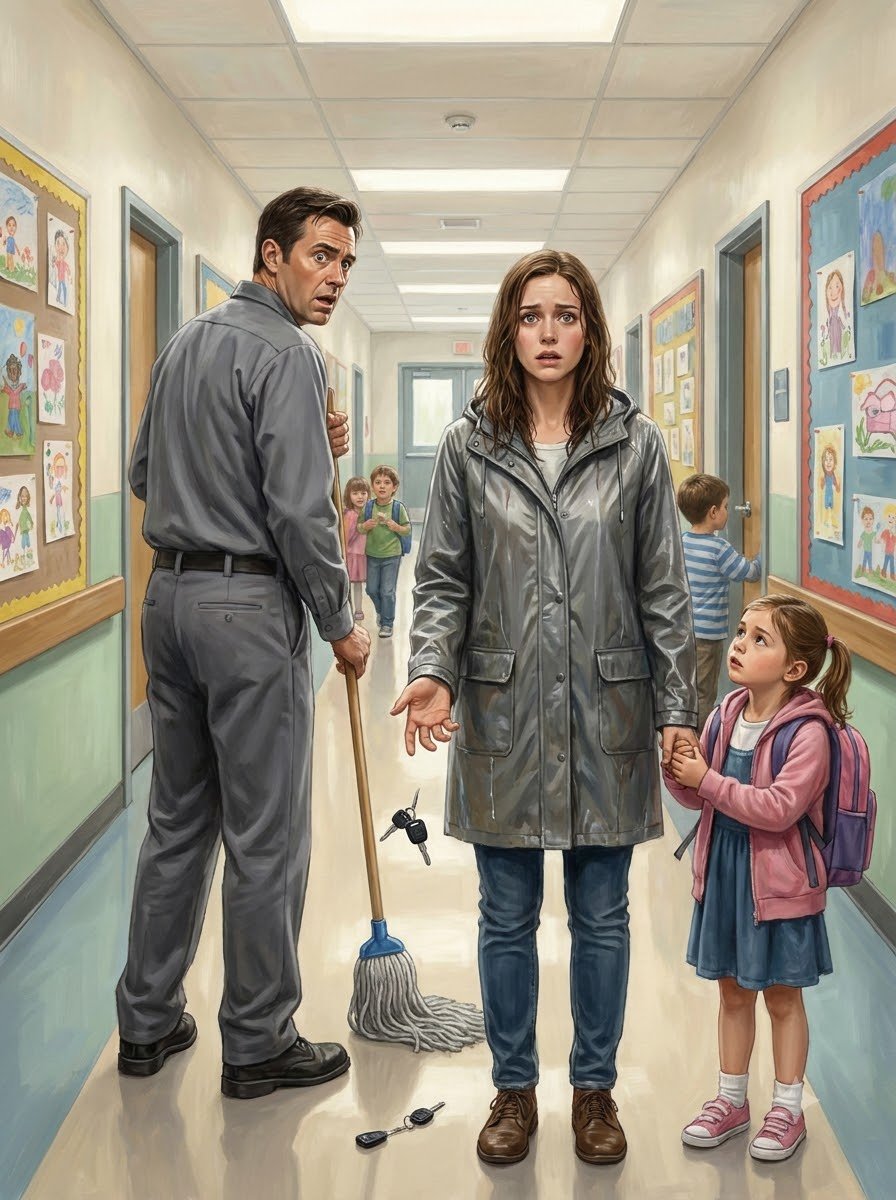
Two years after her husband’s funeral, widow Lauren Hayes heard her six-year-old say she’d seen Daddy mopping the hallway at school. Lauren thought it was grief. Then she saw the new janitor turn around, and found herself staring at her husband’s face, and a secret her mother-in-law had kept for thirty-eight years. Read all 8 chapters below.
A Midnight Chapters original story. All characters and events are fictional.
Chapter 1: “Daddy Works at My School Now”
Ava told me in the car, between a story about a classmate who ate glue and a question about whether fish get thirsty.
“Mommy, Daddy works at my school now.”
I kept my eyes on the road. It was raining in Portland, Maine, the gray October kind that turns the whole city the color of wet slate. My husband, Mark, had been gone for two years. A brain aneurysm, at thirty-six, while he was making pancakes on a Saturday morning. One moment he was flipping blueberry pancakes and singing badly. The next, he was on the kitchen floor.
Ava had been four. The grief counselor told me young children sometimes see their lost parent in strangers. She told me not to correct it too harshly.
“Oh, sweetheart,” I said gently. “Daddy’s in heaven. Remember?”
“I know,” Ava said, with the patience of a six-year-old explaining something to a slow adult. “But he’s also at my school. He was mopping by the library. I said hi, and he looked at me, and then he cried.”
My hands tightened on the wheel.
“Maybe it was someone who looks a little like Daddy,” I said.
“No. It was Daddy’s face.” She kicked her rain boots against the seat. “But his hair is longer. And he didn’t know my name.”
That night, I couldn’t sleep. I sat at the kitchen table with a cup of tea going cold, looking at the framed photo on the windowsill: Mark at the beach, squinting into the sun, grinning, with Ava on his shoulders. The small white scar on his chin from a hockey puck in high school. The crooked front tooth he refused to fix.
I told myself it was nothing. A child’s imagination. A tall man with dark hair.
The next afternoon, I left work early and got to Longfellow Elementary twenty minutes before dismissal. I told the front office I was there to pick Ava up for a dentist appointment. It wasn’t true. I just needed to see.
The hallway outside the library smelled like floor cleaner and crayons. A man in a gray custodian’s uniform was pushing a mop bucket away from me, toward the end of the corridor. Tall. Broad-shouldered. Dark hair that curled over his collar.
My heart was pounding so hard I could hear it.
“Excuse me,” I said.
He stopped. Slowly, he turned around.
My car keys fell out of my hand and hit the floor.
It was Mark’s face. Not like Mark’s face. Mark’s face. The same gray-green eyes. The same strong jaw. The same crooked front tooth.
The man stared at me. All the color drained from his skin.
“Mrs. Hayes,” he whispered.
He knew my name.
Sewn onto his uniform, above the pocket, was a name tag. SAM.
Chapter 2: The Man With My Husband’s Face
“Who are you?” I said. My voice came out as a croak.
He opened his mouth. Closed it. Then he did something I didn’t expect. He backed away from me, step by step, until he bumped into the door of the supply closet. He fumbled with the handle, slipped inside, and shut the door.
I stood alone in the hallway, shaking.
“Lauren?”
Mr. Brennan, the principal, was hurrying toward me, frowning. He was a fussy, anxious man in his fifties who wore sweater vests every day of the year. “Is everything all right? The office said you were picking up Ava early.”
“That man,” I said, pointing at the supply closet. “Who is he?”
“Sam? He’s our new custodian. Started in September. Quiet fellow, very reliable.” He followed my finger to the closed door and blinked. “Is there a problem?”
I couldn’t explain it. I didn’t know how. So I said, “No. I’m sorry. I’m just tired,” and I picked up my keys and went to get my daughter.
At home, after Ava was asleep, I took down our wedding album and sat with it on the living room floor.
I studied every photo of Mark. And I started to notice things.
The man at the school had no scar on his chin. Mark had one, a thin white line, since he was sixteen.
And when Sam had backed away from me, he’d reached for the closet door with his left hand. Mark was right-handed. He couldn’t even write his name with his left.
It wasn’t Mark. It couldn’t be Mark. I had held my husband’s hand in the hospital while the machines went quiet. I had chosen his casket. I had scattered his ashes off the rocks below Portland Head Light, exactly where he’d proposed to me.
But it was Mark’s face.
At eleven p.m., I picked up my phone and called my mother-in-law.
Diane Hayes answered on the fourth ring, her voice thick with sleep. She was sixty-four, a retired nurse, small and sharp and fiercely private. She had raised Mark alone in a tiny house in Biddeford after his father left. She adored Ava. She had always been polite to me, in the careful way of someone who never quite lets you in.
“Lauren? Is Ava okay?”
“Ava’s fine.” I took a breath. “Diane, I need to ask you something, and I need you to tell me the truth. Did Mark have a brother?”
The silence on the line went on so long I thought the call had dropped.
Then, very quietly, she said, “Why are you asking me that?”
“Because I think I just met him.”
Diane hung up.
Chapter 3: What Diane Wouldn’t Say
I drove to Biddeford the next morning after dropping Ava at school. I didn’t call first.
Diane opened the door in her bathrobe, saw my face, and tried to close it again. I put my hand on it.
“Please,” I said. “I’m not here to fight. I’m here because my daughter saw a man with her father’s face and I don’t know what to tell her.”
Diane’s lip trembled. Then she stepped back and let me in.
Her living room was exactly as it always was: spotless, with doilies on the arms of the chairs and a wall of framed photographs of Mark at every age. Mark as a baby. Mark losing his front teeth. Mark in his graduation gown. Mark holding newborn Ava in the hospital.
Diane sat down in her armchair and folded her hands in her lap so tightly her knuckles went white.
“There’s nothing to tell,” she said.
“Diane.”
“Mark was an only child. I don’t know who this man is. People look alike. It happens.” Her voice was rising. “I won’t have you coming into my house two years after my son died and digging up—” She stopped herself.
“Digging up what?” I asked.
She stared at the carpet.
I didn’t push. Instead, I asked if I could look at Mark’s baby things. She kept them in a cedar chest at the foot of her bed. I’d helped her go through it once, after the funeral, when she’d wanted to give Ava a few of his old toys.
She waved her hand toward the bedroom without looking at me.
The cedar chest smelled like mothballs and old paper. Mark’s baby blanket. A pair of tiny knitted booties. A hospital bracelet that said HAYES, BABY BOY. And under all of it, a manila envelope I didn’t remember seeing before.
Inside was a copy of a birth record from Southern Maine Medical Center, dated March 4, 1988.
Mother: Diane Marie Hayes, age 17.
Infant: Male, Twin A, 6 lbs 2 oz.
There was a second line below it.
Infant: Male, Twin B, 5 lbs 11 oz.
And beside the second line, in faded blue ink, someone had written a single word and then crossed it out so hard the pen had torn the paper.
I could still read it.
Adoption.
I walked back into the living room holding the paper. Diane looked up, saw it, and made a sound like something tearing inside her.
“You told everyone he died,” I said softly.
“I told everyone nothing,” Diane whispered. “Nobody ever asked.”
Chapter 4: The Note at the Front Office
Diane wouldn’t say anything more. She cried, and then she asked me to leave, and I did, because I didn’t know what else to do.
The next day, when I picked Ava up from school, the secretary at the front desk handed me a sealed envelope.
“Sam asked me to give you this,” she said. “He seemed nervous. Is everything okay?”
I opened it in the car while Ava sang along to the radio.
Mrs. Hayes,
I’m so sorry I frightened you. I never meant for you or your daughter to find out this way. I was going to quit at the end of the month and leave without ever saying a word. But you deserve the truth, and so does she.
If you’re willing, I’ll meet you anywhere you choose. If you’re not, I understand, and I’ll be gone by Friday.
Sam Cole
His phone number was written at the bottom.
I met him on Saturday morning at a coffee shop on Commercial Street, a busy place full of tourists where I felt safe. My best friend, Nina, sat two tables away pretending to read a book, just in case.
Sam was already there. He’d ordered two coffees and wasn’t drinking either. Up close, in a flannel shirt instead of a uniform, the resemblance was so strong it made me dizzy. But there were differences, too. His face was more weathered. He had laugh lines Mark hadn’t lived long enough to get. And his voice was deeper, with a faint Midwestern flatness.
“I grew up in Ohio,” he said, when I asked. “Dayton. I was adopted as a baby by Ray and Carol Cole. Good people. Ray was a carpenter. I am too.” He turned his coffee cup slowly. “They always told me I was adopted. They didn’t know anything about my birth family. It was a closed adoption.”
“So how did you find us?”
“A DNA test. My wife gave it to me for my birthday, before she passed. Cancer, four years ago.” He swallowed. “About a year ago I finally sent it in. The results came back with one close match. An identical genetic match. Full sibling. The name on the account was Mark Hayes, Portland, Maine.”
My chest went tight.
“I sent him a message,” Sam said. “It said, I think we might be brothers. I waited for weeks. He never answered.” He looked up at me, and his eyes were wet. “Then I searched his name online. And I found his obituary.”
He had found a brother and lost him in the same afternoon.
“I don’t know why I came here,” he said quietly. “His obituary said he loved Longfellow Elementary, that he volunteered there. It asked for donations to the school library. I drove out from Ohio just to see the town. And then I saw the job posting for a custodian, and I…” He shook his head. “I know how that sounds. I just wanted to be near something that was his. I never planned to talk to your daughter. When she said hi to me by the library, she looked so much like the pictures of him as a kid. I couldn’t help it. I cried.”
I believed him. I don’t know exactly why. Maybe because he looked so ashamed.
“There’s something else,” Sam said. He reached into his jacket and slid a folded paper across the table. “My parents kept my adoption file. I got it after my mom passed last spring.”
It was a legal consent form, dated March 9, 1988. Five days after the twins were born.
The birth mother’s signature at the bottom wasn’t Diane’s.
It was her father’s.
Chapter 5: The Principal’s Call
On Monday morning, I was at work when my phone rang. It was the school.
“Mrs. Hayes, this is Mr. Brennan.” His voice was tight and formal. “I wanted you to know that we’ve had to let our custodian go, effective immediately. A staff member reported that he’d been seen watching your daughter on the playground. Given his strange behavior with you last week, I felt obligated to contact the police. They’re speaking with him now. I wanted to assure you Ava is safe.”
I was in my car before he finished talking.
When I got to Longfellow Elementary, there was a police cruiser parked out front. Inside the front office, Sam sat on a plastic chair with his hands clasped between his knees, his face gray. Two officers stood over him. Mr. Brennan hovered nearby in his sweater vest, looking both frightened and self-righteous.
“He’s not dangerous,” I said, before anyone could speak.
The older officer turned. “Ma’am?”
“His name is Sam Cole. He’s my late husband’s identical twin brother. They were separated at birth. He only just found us.” I took out my phone and showed them the photo I’d taken of the birth record. “I know how it looks. But he’s family.”
Mr. Brennan’s mouth fell open.
The officers looked at the photo. They looked at Sam. They looked at the picture of Mark that still hung in the school library, beside the reading nook he’d helped build. The resemblance was impossible to argue with.
They ran Sam’s background. It came back clean. No record. Not even a parking ticket. Twenty-two years as a licensed contractor in Ohio. A widower with a tidy little house he’d rented out to come to Maine.
The officers left. Mr. Brennan apologized to Sam three times, stammering. Sam told him he didn’t blame him for a second.
“You were protecting the kids,” Sam said. “That’s your job. I’d have done the same.”
Then the door to the office opened, and Ava came in with her teacher, clutching her backpack.
She looked at Sam. Then she looked at me.
“Mommy,” she whispered, “is he Daddy?”
I knelt down beside her. “No, baby. He’s not Daddy. But he’s Daddy’s brother. His twin. They were born on the same day, and they got separated when they were babies, and they never got to meet.”
Ava thought about it with the enormous seriousness of a six-year-old.
Then she walked over to Sam, put her small hand on his knee, and asked, “Do you like blueberry pancakes?”
Sam’s face crumpled. “I love blueberry pancakes,” he said hoarsely.
“Daddy did too,” Ava said. “You can be my uncle. If you want.”
Chapter 6: Diane’s Truth
I drove to Biddeford that evening with Ava in the back seat. Sam followed in his pickup truck, but he stayed in the driveway. He said it had to be my decision, and Diane’s, whether she wanted to see him.
Diane opened the door before I knocked. She had seen the truck. She was looking past me at the man sitting behind the wheel, and her face was the color of paper.
“He’s here,” she whispered.
“He’s here,” I said. “And he’s been waiting thirty-eight years to know why.”
We sat at her kitchen table while Ava colored in the living room. And for the first time, Diane told the whole story.
She had been seventeen when she got pregnant. Her father, Frank, was a strict, angry man who worked at the shipyard in Bath and believed his family’s reputation was the only thing they owned. He had wanted her to give the baby up. She refused. When she went into labor with twins, her father was furious. Two babies. No husband. No money.
“I was so exhausted after the delivery,” Diane said, her voice barely a whisper. “They gave me something for the pain. When I woke up, Mark was in the bassinet next to me. The other baby was gone. My father said he’d been too small and too sick. He said he’d died in the night. He said it was God’s mercy.” She pressed her hand to her mouth. “I never got to hold him. I never saw his face.”
“But he didn’t die,” I said gently.
“I found out seven years later.” Diane’s eyes filled with tears. “My father was dying of lung cancer. On his last night in the hospital, he told me. He’d signed the papers himself, pretending to be my guardian, which he was, legally. He’d arranged a private adoption through a lawyer in Portland. A couple from out of state. He said one baby was all I could afford to ruin my life with.”
She was crying openly now.
“I tried to find him,” she said. “For years. I wrote to the lawyer. He’d retired, then died. The records were sealed. The court in Portland told me I had no standing because my father had signed, not me. I wrote letters to agencies in six states. Nothing. Every March fourth, I’d bake two cakes. Mark thought I just really liked cake.”
She laughed through her tears, and it was the saddest sound I’d ever heard.
“Why didn’t you ever tell Mark?” I asked.
“Because I was ashamed,” Diane said. “Because I let my father take my baby while I slept. Because I didn’t fight hard enough. Because I thought if Mark knew, he’d wonder what kind of mother lets that happen.” She looked toward the window, toward the truck in her driveway. “And because I was afraid that if I ever found him, he’d hate me.”
I reached across the table and took her hand.
“He doesn’t hate you,” I said. “He drove all the way from Ohio just to stand in the hallway of a school his brother loved. Does that sound like a man who hates anybody?”
Diane stood up, very slowly, like her body hurt. She went into her bedroom. When she came back, she was holding something in both hands.
It was a tiny knitted baby hat, pale blue, faded with age. Stitched on the band in white yarn was a single letter.
B.
“I made two,” she whispered. “Before they were born. Mark wore his home from the hospital. I kept this one for thirty-eight years.”
Chapter 7: The Lighthouse
Diane asked to meet Sam somewhere that mattered.
So on a cold, bright Sunday morning in November, we drove to Portland Head Light. The old white lighthouse stood on the rocks above the Atlantic, waves crashing white against the cliffs below. It was where Mark had proposed to me. It was where we had scattered his ashes.
Sam was waiting by the railing, his hands jammed into the pockets of his canvas jacket. He’d gotten a haircut. He was wearing a button-down shirt under the jacket, and I realized he had dressed up to meet his mother.
Diane got out of my car. Ava held her hand.
For a long moment, Diane and Sam just looked at each other across twenty feet of windblown grass.
Then Diane let go of Ava’s hand and walked to him.
She stopped in front of him. She was so small next to him. She reached up and touched his face, very lightly, with her fingertips. His cheek. His jaw. The place on his chin where Mark’s scar would have been, if they’d lived the same life.
“I’m so sorry,” she whispered. “I’m so sorry. I didn’t know. I swear to God I didn’t know you were alive.”
“I know,” Sam said, and his voice broke completely. “I know, Mom. It’s okay.”
It was the first time anyone had ever called her that except Mark.
Diane pulled the tiny blue hat from her coat pocket and pressed it into his hands. He turned it over and saw the letter on the band, and he started to cry too, standing on the rocks above the ocean with the wind whipping his hair.
Ava tugged on my sleeve. “Why is everyone crying?”
“Because they found each other,” I said, wiping my eyes. “Sometimes people cry when they’re very happy.”
Ava considered this. Then she marched across the grass, wrapped one arm around her grandmother’s leg and the other around her new uncle’s, and announced loudly, “Okay. Group hug. That’s the rule.”
Diane laughed, a wet, astonished laugh. Sam scooped Ava up into his arms the way Mark used to, and for one strange, aching second, the three of them looked exactly like a photograph I’d always wished I could take.
Later, Sam stood alone at the railing, looking out at the water where his brother’s ashes had gone.
“I’m sorry I didn’t find you sooner,” he said quietly to the waves. “I would’ve liked to know you.”
I came and stood beside him.
“He would’ve liked you,” I said. “He always wanted a brother. He used to say that’s why he married someone with three sisters.”
Sam laughed. It wasn’t Mark’s laugh. It was lower, rougher, his own.
I was glad.
Chapter 8: Ava’s Family Tree
In May, Ava’s first-grade class did a project called My Family Tree.
Each kid had to make a poster and present it to the class. Families were invited to watch. Sam and Diane and I sat on tiny plastic chairs in the back of Ms. Lopez’s classroom, knees up near our chins, holding cups of lemonade.
So much had changed in six months.
Diane had come to dinner every Sunday since the lighthouse. She and Sam talked for hours, about Ohio, about his parents, Ray and Carol, whose graves Diane had insisted on visiting, about the wife he’d lost and the brother he never met. She knitted him a scarf. It was lopsided. He wore it every single day all winter.
Sam had moved to Portland for good. He’d started his own small carpentry business and had more work than he could handle. Mr. Brennan, still mortified, had hired him to rebuild the school’s library reading nook, the one Mark had built years ago. Sam had worked on it every weekend for two months. When it was finished, there was a small brass plaque on the bench that read: In memory of Mark Hayes, who loved stories. Built by his brother.
Ava was the sixth kid to present. She carried her poster to the front of the room with both arms wrapped around it, cleared her throat importantly, and held it up.
It was covered in glitter and stickers and drawings in thick crayon. At the top of the tree was a small yellow sun with a smiling face.
“This is my family tree,” Ava announced. “At the top is my daddy. He’s in heaven, so I made him the sun, because the sun is in the sky and it’s always watching even when you can’t see it.”
My throat closed up. Beside me, Diane reached for my hand.
“This is my mommy,” Ava went on, pointing. “She makes good spaghetti. This is my grandma Diane. She was really sad for a long time but now she’s happier. And this is my Uncle Sam.”
She pointed to a tall stick figure with crayon-brown hair holding what appeared to be either a hammer or a lollipop.
“Uncle Sam is my daddy’s twin,” Ava told the class. “That means they were born on the same day and they had the same face. But they got lost from each other when they were babies. And then Uncle Sam found us.” She paused, thinking hard. “He has Daddy’s face. But he has his own laugh. And he makes blueberry pancakes, but he doesn’t sing while he does it. He’s still learning.”
The whole class laughed. Sam put his face in his hands, and his shoulders were shaking, and I couldn’t tell if he was laughing or crying. It was probably both.
“The end,” Ava said, and bowed.
Afterward, walking out to the parking lot in the soft spring sunshine, Ava ran ahead of us, her poster flapping in the breeze. Diane walked between Sam and me, holding each of us by the arm.
“Every March fourth,” she said suddenly, “I used to bake two cakes. And I’d sit there alone after Mark went to bed, looking at that second cake, wondering if my other boy was having a birthday somewhere.”
“I always had a birthday,” Sam said gently. “Ray and Carol made sure of that.”
“Next March,” Diane said, “I’m baking two cakes again.” She squeezed his arm. “And this time, I’m going to watch you eat yours.”
Ahead of us, Ava had stopped at the car. She turned around and waved her poster over her head like a flag, the glitter catching the sunlight.
“Come on!” she shouted. “Uncle Sam promised pancakes!”
Sam smiled. It wasn’t Mark’s smile. It was his own.
And somehow, that made it even better.
The End.
Midnight Chapters publishes original fiction. All names, characters, places, and events in this story are imaginary. Any resemblance to real persons or events is coincidental.