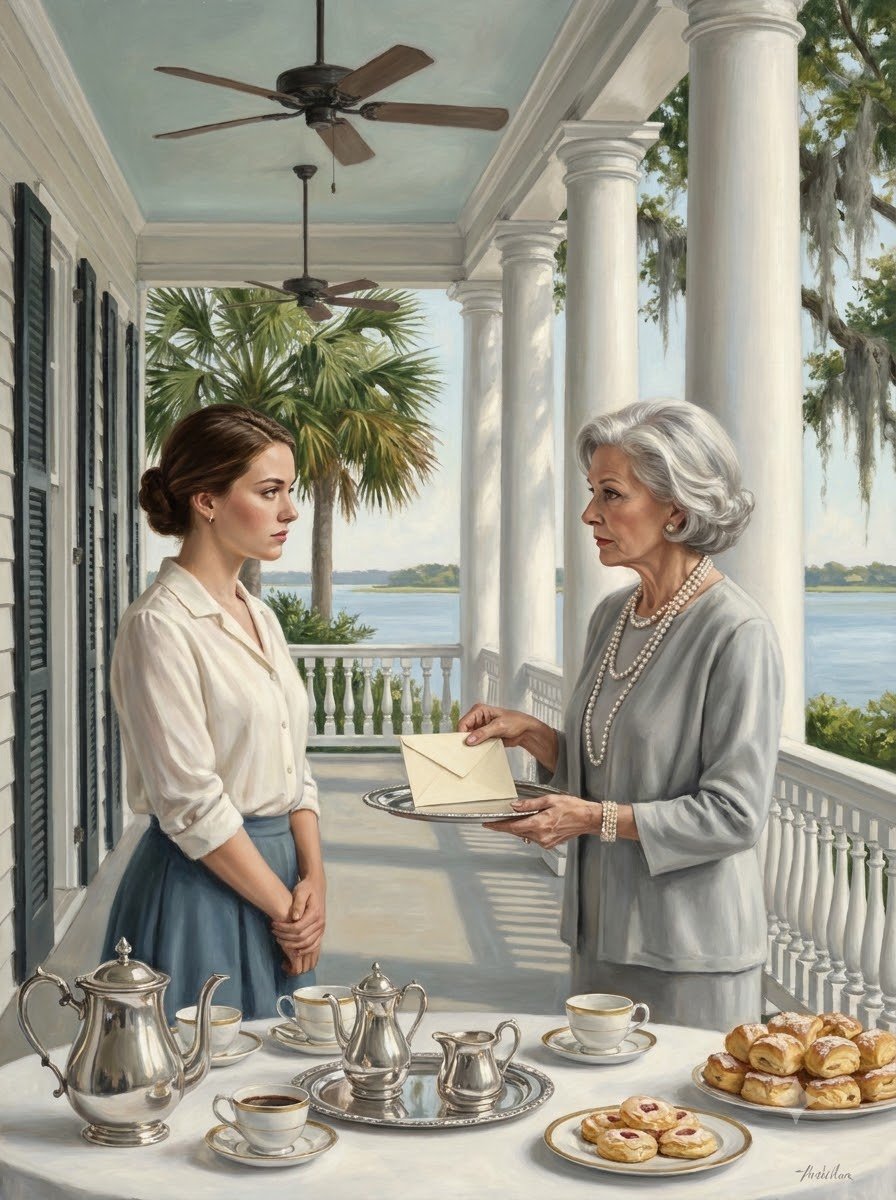
At Sunday brunch, Vivian Ashford slid a $250,000 check across the table and told her daughter-in-law to leave her son within thirty days. Hannah said thank you and took it. What Vivian didn’t know was that Hannah was a forensic accountant, and she had already noticed the one thing the Ashford family was desperate to hide. Read all 8 chapters below.
A Midnight Chapters original story. All characters and events are fictional.
Chapter 1: The Check on the Silver Tray
My mother-in-law waited until the shrimp and grits were served.
Sunday brunch at Ashford Hall was a tradition older than anyone at the table. The inn had stood on the Charleston waterfront for almost a hundred years: three stories of white columns, wide porches, and ceiling fans that turned so slowly they seemed to be thinking. Vivian Ashford had run it for thirty-five of those years. She ran her family the same way she ran the inn: beautifully, and with no room for argument.
My husband, Owen, had been called away from the table by the front desk. Something about a double-booked wedding party. Vivian watched him go, folded her napkin into a perfect triangle, and nodded to the server.
He set a small silver tray in front of me. On it was a cream-colored envelope.
“Go on,” Vivian said. “Open it.”
Inside was a cashier-style check drawn on the Ashford Hall business account. It was made out to Hannah Price Ashford, in Vivian’s elegant handwriting, for two hundred and fifty thousand dollars.
In the memo line she had written two words: For leaving.
I looked up. Vivian was smiling the way she smiled at guests who complained about the Wi-Fi.
“Thirty days,” she said. “You’ll tell Owen it isn’t working. You’ll say you miss Ohio, or your career, or whatever it is people from Ohio miss. You’ll sign the papers my lawyer prepares. And you will never tell him about this conversation.”
“Why?” I asked. My voice came out steadier than I felt.
“Because you are a perfectly nice girl, Hannah, and my son needs more than a perfectly nice girl.” She sipped her sweet tea. “Owen has responsibilities. This inn has responsibilities. There are families in Charleston who understand that, and families who don’t.”
“You mean the Whitmores.”
Her eyebrow twitched. Just slightly. “Caroline Whitmore has always been fond of Owen.”
I had been married to Owen for two years. I’d met him at a conference in Columbus where he was speaking about historic preservation and I was speaking about embezzlement detection, and we’d ended up in the same hotel bar arguing about whether old buildings or old ledgers told better stories. I moved to Charleston eight months later. Vivian had never once called me by my married name.
I looked down at the check again. And then I looked past it, at the dining room around us.
At the water stain spreading across the ceiling above the bay window, the one that had been there since I’d moved in. At the server’s frayed shirt cuffs. At the stack of unopened envelopes I’d noticed on the front desk last week, three of them stamped FINAL NOTICE in red.
I folded the check, slipped it back into the envelope, and put it in my purse.
“Thank you, Vivian,” I said.
For the first time since I’d known her, my mother-in-law looked surprised.
Chapter 2: What Owen Said
I told Owen in the car, before we’d even pulled out of the inn’s gravel lot.
He didn’t say anything while I talked. His hands tightened on the steering wheel until his knuckles went white. When I took the envelope out of my purse and showed him the memo line, he stopped the car in the middle of East Bay Street, and a tourist carriage behind us rang its bell.
“I’m going back in there,” he said.
“Owen.”
“She tried to buy you, Hannah. Like you were a— like this was—” He couldn’t even finish.
“I know.” I put my hand on his arm. “But before you go in there and yell at her, I need you to answer one question for me.”
He looked at me.
“Why does your mother have two hundred and fifty thousand dollars to throw away,” I said, “when the roof over the dining room has been leaking for two years?”
He opened his mouth. Then closed it.
“I’m a forensic accountant,” I said gently. “Finding the money that doesn’t add up is literally my job. And nothing about Ashford Hall adds up right now. The vendors are calling the front desk. The linen service switched you to cash on delivery last month. Your mom let two housekeepers go in September and told everyone they quit. And yesterday, I saw her on the phone in the garden, crying. She hung up the second she saw me.”
Owen leaned his head back against the seat and closed his eyes.
“She won’t let me see the books,” he said quietly. “She hasn’t for years. I manage events and restoration. She handles the money. She always says it’s under control.”
“I don’t think it is.”
A car behind us honked. Owen started driving again, slowly.
“So what do we do?” he asked. “Give the check back? Tell her we know?”
I looked out the window at the old houses going by, pastel and proud and slowly sinking into the marsh mud they’d been built on.
“Not yet,” I said. “First I want to know exactly what she’s hiding. Then we decide.”
He was quiet for a long moment.
“You’re not actually going to leave me,” he said. It wasn’t quite a question.
I laughed, and then I saw his face and stopped laughing.
“Owen Ashford,” I said, “it would take a lot more than a quarter of a million dollars to get rid of me. Your mother should have done her homework.”
Chapter 3: The Numbers Don’t Lie
Most people don’t realize how much of a family’s private life is written down in public places.
It took me three evenings at the kitchen table with my laptop and a pot of coffee.
The Charleston County Register of Deeds was the first stop. Ashford Hall had been owned free and clear by the Ashford family since 1931. Then, six years ago, eight months after Owen’s father, Richard, died, Vivian had taken out a mortgage on the property. A big one. Then a second loan, three years later. Both with Lowcountry Federal Bank.
Combined balance: about 1.4 million dollars.
The second stop was the court filings. Four months ago, Lowcountry Federal had recorded a notice of default. Vivian had stopped making payments in the spring.
The third stop was a commercial real estate listing I found almost by accident, buried on a site where banks advertise loans they want to get rid of. Banks do that sometimes with troubled loans. Rather than go through a long, ugly foreclosure, they sell the debt itself to an investor at a discount, and let the investor deal with the borrower.
There it was. Distressed note for sale. Historic waterfront hospitality property, Charleston, SC. Sealed bids due December 6.
Twenty-one days away.
Whoever bought that note would effectively own Ashford Hall’s future. They could foreclose. They could force a sale. They could take the inn and do whatever they wanted with it.
I sat back and stared at the screen. Then I picked up Vivian’s check and looked at it again. The account number. The bank.
I logged into the inn’s public business filings and cross-checked.
The check was drawn on the Ashford Hall operating account. The same account that paid the staff.
“Owen,” I called. He came in from the porch. “When is payroll?”
“The fifteenth. Friday. Why?”
I turned the laptop around so he could see. “Because if I deposit this check, I’m pretty sure it’ll clear. And if it clears, I’m pretty sure there won’t be enough left in that account to pay your forty-one employees.”
He sat down hard.
“She’d rather bankrupt the inn than let me stay married to you,” I said. “Or else she’s so deep in this that she can’t see straight anymore.”
“Or both,” Owen said hoarsely.
Chapter 4: Caroline Whitmore
The next afternoon, someone knocked on our door.
I opened it and found Caroline Whitmore standing on our porch in a linen dress and enormous sunglasses, holding a box of pastries from the French bakery on King Street like a peace offering.
I’d met Caroline exactly twice, at Vivian’s Christmas parties. Both times, Vivian had seated her next to Owen.
“I’m not here to steal your husband,” Caroline said before I could speak. “I promise. Can I come in? This is going to sound insane.”
We sat at my kitchen table. She took off her sunglasses. Her eyes were red.
“My father thinks I’m at a yoga retreat,” she said. “He would kill me if he knew I was here. But I can’t do this anymore.”
“Do what?”
“Pretend.” She twisted her napkin. “Vivian thinks if Owen marries me, my father will rescue Ashford Hall. Pay off the debt as a wedding present. Keep it in the family. That’s what Daddy has been letting her believe for a year.”
“But that’s not what he’s planning,” I said slowly.
Caroline shook her head. “Daddy doesn’t rescue anything. He buys it cheap. He owns half the hotels on the peninsula, and he’s wanted Ashford Hall since before I was born. He told his lawyer last week that he’s going to bid on the bank’s note. Once he owns the debt, he forecloses. He’ll gut it and turn it into luxury condos. Vivian loses everything.” She looked at me miserably. “And the wedding was never going to happen. I’m engaged. To a public-school music teacher in Asheville. Daddy doesn’t know.”
I stared at her.
“Vivian’s being played,” I said. “She paid me to leave so Owen would marry a woman who doesn’t want him, so her father could steal the inn anyway.”
“Pretty much.” Caroline laughed shakily. “When I heard she’d tried to pay you off, I couldn’t sleep. Owen’s always been kind to me. And so have you, the two times I’ve met you. You were the only person at that Christmas party who asked me what I wanted to do with my life.”
After she left, I sat at the table for a long time.
Then I opened my laptop and pulled up the bank’s bid package for the note on Ashford Hall.
Minimum bid: $420,000.
I did the math. Vivian’s check: $250,000. Our savings: $61,000. The money Owen’s grandfather had left him in a trust he’d never touched: $215,000.
It was enough. Barely.
When Owen came home, I was still sitting there with a legal pad covered in numbers.
“Hannah?” he said. “What are you doing?”
I looked up at him.
“I’m going to cash your mother’s check,” I said. “And I’m going to use it to save her.”
Chapter 5: The Bid
I deposited the check on Monday morning at nine a.m.
By Monday afternoon, it had cleared. By Monday evening, the Ashford Hall operating account had $3,108 left in it, and payroll was due Friday.
On Tuesday, I walked into Lowcountry Federal and wired $58,000 of that check straight back into the inn’s operating account, quietly, as a deposit from Owen’s events budget. Forty-one people were going to get paid on Friday, and none of them would ever know how close they’d come to not being paid.
“You just gave back a quarter of the bribe,” Owen said in the car.
“I gave back the part that belonged to people who never did anything wrong,” I said. “The rest belongs to your mother’s mistakes. And we’re going to buy those.”
We spent the next ten days preparing.
I hired a real estate attorney named Patricia Okonkwo who had handled distressed loan sales for twenty years and looked at our proposal with the expression of a woman who had seen everything and still found this interesting.
“You understand what you’re doing,” she said. “If you win, you’ll own a defaulted loan on a property worth maybe three million on paper, with a borrower who has no money and a roof that’s falling in.”
“The borrower is my mother-in-law,” I said.
Patricia put down her pen. “Oh, honey,” she said. “That is either the best or the worst idea I’ve heard all year.”
The bids were due on December 6 at five p.m.
Ours went in at 4:30, with a cover letter Patricia helped me write. We offered $455,000, all cash, with a fourteen-day close. We also explained exactly who we were: the borrower’s son and daughter-in-law, prepared to restructure the loan, keep the property operating, retain the staff, and protect the bank from a long, public foreclosure on one of Charleston’s most beloved historic buildings.
At 4:52, Patricia texted me. Whitmore Holdings just submitted. Rumor is $510K.
My stomach dropped.
We waited three days. I barely slept.
On December 9, at 10:14 a.m., Patricia called.
“The bank went with you,” she said. “Whitmore bid higher, but his offer had a sixty-day close and he made it clear he’d foreclose immediately. The bank’s board didn’t want their name on the headline when one of the oldest inns in Charleston got torn down for condos. Your letter mattered.”
I put my hand over my mouth.
“Congratulations, Mrs. Ashford,” Patricia said. “You now hold the note on Ashford Hall.”
Chapter 6: The Centennial Gala
Vivian had been planning the Ashford Hall Centennial Gala for two years.
It was set for December 20, exactly one hundred years after the inn first opened its doors. Three hundred guests. A string quartet on the porch. Oysters flown in from Bulls Bay. A champagne tower in the ballroom under the crystal chandelier her grandmother had brought back from New Orleans.
And, according to the gossip columns, a special announcement.
I had moved out of the house we shared, technically. I was staying with my sister, Leah, who lived twenty minutes away in Mount Pleasant. Owen told his mother I’d gone back to Ohio to think things over. Vivian had smiled and patted his hand and said, “Sometimes these things work out for the best, darling.”
She didn’t ask him a single question about how he felt.
On the night of the gala, Owen texted me at seven. She’s telling people. Mom just told the mayor’s wife that Caroline and I are “reconnecting.”
At 7:40, another text. Bradford Whitmore just pulled Mom into the library. Door’s closed. She came out looking like she’d seen a ghost.
I found out later what he’d told her.
Bradford Whitmore had assumed he’d win the bid. When he didn’t, he called the bank to find out who had beaten him. The bank wouldn’t say. So he decided to tell Vivian the truth anyway, because by then it didn’t matter to him anymore. He told her the note on Ashford Hall had been sold. That whoever owned it now could foreclose whenever they liked. That he’d never had any intention of paying her debts, and that his daughter wasn’t going to marry her son. Then he poured himself a bourbon from Vivian’s own decanter, wished her luck, and left.
At 8:15, Owen texted again. She’s going to make a speech. Hannah, I think she’s going to fall apart up there.
I was already in the car.
Chapter 7: Who Holds the Note
I walked into the ballroom just as Vivian stepped up to the microphone.
She looked perfect. Silver hair swept up, pearls, a midnight-blue gown. Only someone who had spent two years watching her closely would have noticed her hands trembling on the podium.
“One hundred years,” she began, and her voice cracked. She cleared her throat. “One hundred years ago tonight, my husband’s great-grandfather opened these doors…”
She stopped. She looked out at three hundred faces. Then her eyes found me, standing at the back of the room in a simple black dress, and all the color drained from her face.
People turned to look.
I walked down the center aisle between the tables. Owen met me halfway and took my hand. Together, we climbed the two steps to the small stage.
“Hannah,” Vivian whispered. “What are you doing here?”
“I think we should talk somewhere private,” I said quietly. “But I’ll do it here if you want.”
She stared at me. Then, very softly, she said, “Someone bought the note. Bradford says I’ve lost everything.”
“No,” I said. “Someone bought the note. And she’s not going to take anything from you.”
I opened my clutch and handed her a single sheet of paper. It was the assignment document from Lowcountry Federal, transferring the loan on Ashford Hall to a new holder. At the bottom, it listed the buyer’s name.
Hannah Price Ashford and Owen R. Ashford.
Stapled to the back was a photocopy of a canceled check. Pay to the order of Hannah Price Ashford. Two hundred fifty thousand dollars. Memo: For leaving.
Vivian read it. Then she read it again.
“You used my money,” she said. “To buy my debt.”
“I used your money to make sure Bradford Whitmore didn’t turn your husband’s family home into condos,” I said. “And I used part of it to make sure your staff got paid last Friday, because the check you wrote me nearly emptied the account.”
Her knees seemed to give way. Owen caught her elbow and helped her into a chair at the edge of the stage. The ballroom had gone completely silent.
“Why?” Vivian whispered. “After what I did to you, why would you do this?”
“Because Owen loves this place,” I said. “And because I love him. And because I’m not you, Vivian.”
She put her face in her hands. When she lifted it again, she wasn’t the queen of Ashford Hall anymore. She was a sixty-four-year-old widow who had been carrying something terrible alone for six years.
“Richard gambled,” she said, so quietly that only Owen and I could hear. “For years. Cards, then horses, then online. When he died, he left debts I didn’t even know existed. Men came to the house. I mortgaged the inn to pay them off so no one would ever know. So Owen would never have to know what his father was.” Tears were streaming down her face. “I thought if Owen married well, the Whitmores would fix it. I thought I could keep the secret forever.”
Owen knelt beside her chair. “Mom,” he said. “You don’t have to carry this by yourself anymore.”
Chapter 8: The New Terms
We signed the new loan agreement on New Year’s Eve, at the long mahogany table in the inn’s library.
Patricia drew it up. The terms were simple.
Vivian would keep her home in the inn’s east wing for as long as she wanted. The loan would be restructured over thirty years, at a fair interest rate, with payments the inn could actually afford. Owen would take over as general manager. I would serve as chief financial officer, with full access to every account, every invoice, and every unopened envelope stamped FINAL NOTICE. No staff would lose their jobs. The roof would be fixed by spring.
And there was one more condition, which wasn’t in the legal document because it couldn’t be.
Vivian had to tell the truth. To everyone.
She did it at the staff meeting on January 2. She stood in the kitchen in front of forty-one employees, some of whom had worked for her for twenty years, and told them about the debt and the gambling and the check and how close the inn had come to closing. She apologized to the two housekeepers she’d let go in September, both of whom Owen had hired back the day after the gala.
Then she turned to me in front of all of them.
“Hannah,” she said. “I was wrong about you. Not just a little wrong. Completely wrong. You are exactly what this family needed, and I nearly threw you away for a man who would have thrown all of us away.” She swallowed. “I’m sorry.”
Nobody said anything for a moment. Then Ruthie, the head housekeeper, who was seventy and had known Owen since he was in diapers, started clapping. Then everyone did.
Six months later, on a warm June evening, the new copper roof gleamed over the dining room, and Ashford Hall was booked solid for the entire summer. Caroline Whitmore married her music teacher in our garden. Her father didn’t attend. Vivian cried through the whole ceremony and insisted on paying for the champagne.
That night, after the last guests had gone, Vivian found me in my new office behind the front desk.
On the wall above my desk hung a framed photocopy of her check. Under it was a small brass plate that Owen had engraved as a joke.
The best investment Ashford Hall ever made.
Vivian stood looking at it for a long time.
“Two hundred and fifty thousand dollars,” she said finally, “to try to make you leave.”
“Yes,” I said.
“And instead, I bought myself a daughter-in-law who saved my home, my son, and my soul.” She turned to me and, for the first time since I’d known her, she smiled with her whole face. “Richard would have said I got a bargain.”
She hugged me then. Awkwardly, stiffly, like someone who hadn’t hugged anyone in a long time and wasn’t quite sure how it worked anymore.
But she held on longer than I expected.
The End.
Midnight Chapters publishes original fiction. All names, characters, businesses, and events in this story are imaginary. Any resemblance to real persons, companies, or events is coincidental.