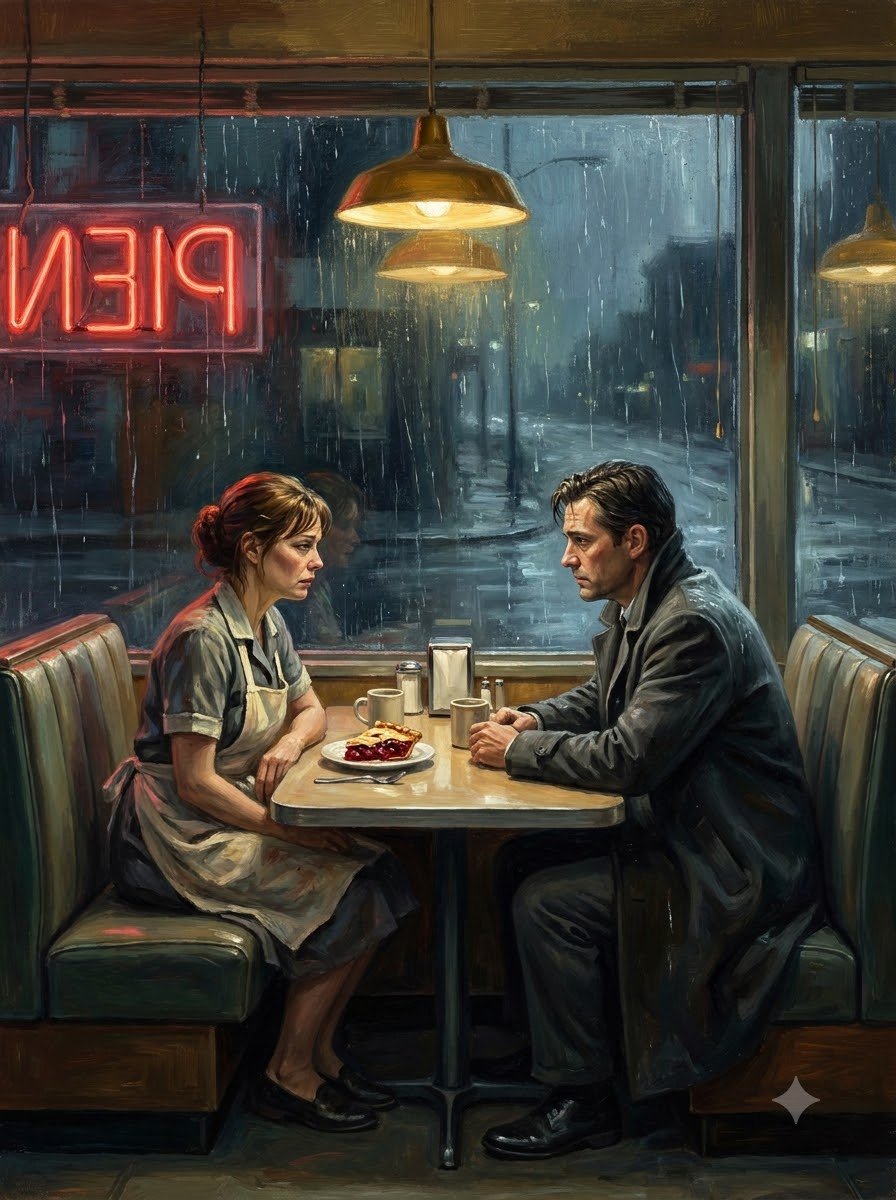
At midnight in a nearly empty diner, a soaked stranger tried to leave single mom Rosie Delgado a $500 tip. She gave it back, even though her rent was overdue. Three weeks later, with the diner about to close forever, she found out why he had really walked through that door, and what her late father had to do with it. Read all 8 chapters below.
A Midnight Chapters original story. All characters and events are fictional.
Chapter 1: The Man Who Ordered Pie at Midnight
He came in at 11:52 on a Tuesday, in the kind of rain that makes the neon sign outside Mabel’s Diner buzz and flicker.
I remember the time because I was counting minutes. My shift ended at one. My son Eli was asleep at my neighbor’s apartment, and his inhaler was almost empty, and the pharmacy wanted forty-two dollars I didn’t have until Friday.
The man stood dripping on the mat for a moment as if he’d forgotten why he’d opened the door. He was maybe forty, tall, in a charcoal overcoat that was much too expensive for our part of Joplin, Missouri. His dark hair was plastered to his forehead. He looked around the diner the way people look at a house they grew up in.
“Sit anywhere, hon,” I said.
He chose booth six, the one by the window with the cracked red vinyl we’d covered with duct tape. Nobody ever chose booth six.
“Coffee?” I asked.
“Please.” His voice was rough. “And a slice of cherry pie. If you still have cherry.”
“We always have cherry.”
Something moved across his face when I said that. Not a smile, exactly. More like a door opening and closing.
I brought the coffee and the pie, and he didn’t touch either. He just sat with his hands wrapped around the mug, staring out at the rain. On his left wrist, under the cuff of his coat, I could see a white plastic hospital bracelet. Not a patient band. A visitor band, the kind they give family in the ICU.
I know those bracelets. I wore one for three weeks when my dad was dying.
At 12:40, Carl the cook went out back for a smoke, and the diner was just me, the hum of the pie case, and the man in booth six. I wiped the same section of counter four times. Then I poured myself a cup of coffee, walked over, and slid into the booth across from him.
I’m not supposed to do that. Mr. Pruitt, who owns Mabel’s, docks us for sitting down on shift.
“Who was it?” I asked quietly.
He looked at me for the first time. His eyes were red-rimmed and very tired.
“My mother,” he said. “Two hours ago. St. John’s.”
“I’m sorry.”
“She was sick for a long time. I should be ready.” He turned the mug in his hands. “I got in my car and I didn’t know where to go. And then I was here.”
“Well,” I said, “you picked the right place. Nobody should eat cherry pie alone at midnight.”
He let out a breath that was almost a laugh. Then he picked up his fork.
We talked until almost one. He didn’t tell me his name, and I didn’t ask. He told me his mother used to work double shifts and would sing old Patsy Cline songs to stay awake. I told him my dad used to be a cook and would burn exactly one pancake every Sunday on purpose so I could pretend to be a food critic.
When Carl came back in, the man stood up, put on his wet coat, and laid something on the table under his saucer.
“Thank you,” he said. “For not letting me be alone tonight.”
He was out the door before I picked up the saucer.
Under it were five crisp one-hundred-dollar bills.
Chapter 2: Five Hundred Dollars on a Paper Napkin
I stood there holding the money for a long time.
Five hundred dollars was my rent, almost. It was Eli’s inhaler and the electric bill and the shoes he’d been outgrowing since September. It was the first night in a year I might sleep without doing math in my head.
“Rosie,” Carl said from the grill, “you’re shaking.”
I didn’t decide to run. My feet did it.
The rain hit me like a bucket of cold water. The man was halfway across the parking lot, unlocking a black sedan.
“Hey!” I shouted. “Mister!”
He turned. I ran up to him, soaked through, my apron dripping, and pushed the bills into his hand.
“I can’t take this,” I said.
He stared at me. “It’s a tip.”
“It’s five hundred dollars for a slice of pie and some coffee.”
“It’s five hundred dollars for the worst night of my life being a little less bad.” He tried to hand it back. “Please. You obviously need it.”
That stung more than it should have. “Everybody in that diner needs it,” I said. “That’s not the point. You were hurting. I sat with you. That’s not something you pay for.”
He looked at me for a long moment, rain running off his face.
“My dad used to say that,” I added, quieter. “Kindness isn’t on the menu. You don’t charge for it.”
Something changed in his expression. He opened his mouth like he was going to ask something, then closed it.
Finally, he peeled off one bill and folded the rest back into his wallet. “Fine. But you’re taking this one. That’s the law of tipping. You can’t argue with the law.”
I laughed despite myself and took the hundred.
He got in his car. I watched his taillights disappear into the rain and went back inside, shivering.
On the table at booth six, tucked under the coffee mug, was a paper napkin. He’d written on it in neat, slanted handwriting:
Your dad sounds like a good man. Thank you, Rosie.
I hadn’t told him my name. Then I looked down at my name tag and felt silly.
The next morning, Mr. Pruitt called me into the back office. He was a heavy man in his sixties who smelled like cigars and breath mints, and he had the security camera footage pulled up on his computer.
“Sitting down on shift,” he said, tapping the screen. “Thirty-eight minutes. That’s coming out of your check.”
“There was no one else in the diner.”
“Rules are rules, Rosie.” He smirked. “And I’ll be taking my cut of whatever that guy left you. House policy on large tips.”
I’d never heard of that policy. But I handed him the hundred-dollar bill anyway, because I couldn’t afford to lose this job.
I didn’t know yet that in three weeks, I’d lose it anyway.
Chapter 3: The Closing Notice
The notice went up on a Monday morning, taped to the kitchen door with packing tape.
Mabel’s Diner will permanently close on Saturday, November 30. The property has been sold. Thank you for your service.
That was it. Nineteen people were losing their jobs, and Mr. Pruitt had given us eleven words and a thank-you.
Dolores, who had waited tables at Mabel’s for thirty-one years, sat down on an overturned milk crate and cried. Carl punched the walk-in freezer door so hard he dented it. Marcus, our nineteen-year-old dishwasher who was putting himself through community college, just kept staring at the paper like he was waiting for it to say something else.
“Who bought it?” I asked Mr. Pruitt when he came in at ten.
“Developer out of Kansas City.” He didn’t even stop walking. “They’re putting up a car wash. Prime corner lot. It’s business, Rosie.”
“Business,” Dolores repeated after he left. “This place fed half this town through two recessions. Your daddy kept it alive when Pruitt’s father was too drunk to show up.”
That was true. My father, Manny Delgado, had been the cook at Mabel’s for twenty-two years. He was the reason the cherry pie was famous. He used to say Mabel’s wasn’t a restaurant; it was a front porch with a grill.
After he died, I took a job waiting tables here because it was the only place in town where I still felt close to him.
That afternoon, during the slow hour, I walked to the wall by the register where the old photographs hung. Decades of them: Little League teams Mabel’s had sponsored, church groups, the 1987 flood when the diner served free food out of the parking lot.
My dad was in a lot of them. My favorite was from 1995. He stood behind the counter in his white apron, grinning, with a plate of pancakes in each hand. On the stools in front of him sat a tired-looking woman in a waitress uniform from a different restaurant, and a skinny boy of about nine with a cowlick and a too-big jacket, digging into a stack of pancakes like it was the first meal he’d had in days.
I’d always wondered who they were. My dad never said. When I asked, he’d just smile and say, “Somebody who needed breakfast.”
I was still looking at that photo when the bell over the door jingled.
I turned around.
The man from booth six was standing in the doorway. Dry, this time. In a navy sweater instead of the overcoat. And he wasn’t looking at me.
He was looking at the photograph.
Chapter 4: The Photograph by the Register
He walked straight past the counter and stopped in front of the wall. He didn’t say anything for a long time.
Then he reached out and touched the glass over the skinny boy with the cowlick.
“That’s me,” he said quietly. “And that’s my mom.”
I put down the coffee pot.
“We lived in our car that year,” he said. “Behind the bowling alley on Seventh Street. My mom worked mornings at the truck stop out on the highway and nights cleaning offices. She’d bring me here before school because your dad told her she could.”
“My dad?”
He turned to me. “Manny Delgado. You’re his daughter, aren’t you? You have his eyes. And you said the same thing he used to say. About kindness not being on the menu.” He shook his head slowly. “When you said that in the parking lot, I almost fell over.”
My throat felt tight. “He fed you.”
“For almost two years. Every morning. Pancakes, eggs, orange juice, sometimes a slice of cherry pie if it was somebody’s birthday or if I’d done well on a test. He never let my mom pay. She tried. She’d leave a quarter or two on the counter, and he’d slip it back into my jacket pocket.” His voice broke a little. “He used to say I was the restaurant critic, and he needed my professional opinion.”
I laughed, and it came out wet. “He burned one pancake every Sunday.”
“So I’d have something to complain about,” he said, smiling. “I know.”
We stood there in front of the photograph, two strangers who apparently weren’t strangers at all.
“My name’s Graham,” he said. “Graham Lindell.”
“Rosie.”
“I know.” He smiled again. “Your name tag.”
“Why did you come back?”
He took a breath. “My mom passed three weeks ago. That night, I drove around for an hour and ended up here without meaning to. And after you gave back the money, I couldn’t stop thinking about it. So I came back to find your dad. To finally thank him.” He hesitated. “Is he working today?”
I looked at the floor.
“He died four years ago,” I said. “Pancreatic cancer. Right here in Joplin.”
Graham closed his eyes. He was quiet for so long that Dolores came over from the counter to see if he was all right.
“I waited too long,” he said finally. “I always told myself I’d come back when I’d made something of myself. When I could repay him properly. And I kept moving the line.”
“He wouldn’t have taken it,” I said. “You know that.”
“I know.” He looked around the diner, at the cracked booths and the faded menus and the hand-lettered sign over the pie case. Then his eyes landed on the closing notice taped to the kitchen door.
“What’s that?”
Chapter 5: What Pruitt Didn’t Want Anyone to See
I told him everything: the developer, the car wash, the nineteen jobs, the eleven words on a piece of paper.
He listened without interrupting. When I finished, he asked only one question. “Who’s Pruitt?”
“The owner. His father bought the place in the seventies. Pruitt inherited it.”
Graham nodded slowly. “Can I ask you something personal, Rosie? Does he take part of your tips?”
I stared at him. “How do you know that?”
“Because you gave back four hundred dollars and kept one hundred. And I’d bet anything you don’t have that one hundred anymore.”
I didn’t answer. I didn’t need to.
He left a few minutes later, after drinking a cup of coffee and ordering a slice of cherry pie to go. He paid at the register with exact change and left a normal, polite tip. I almost felt disappointed, and then I felt ashamed for feeling disappointed.
But his question stayed with me.
That night, after close, I stayed behind to do the side work. Mr. Pruitt had left early, as always. His office door was usually locked, but tonight it was open a crack, and the computer was still on.
I knew I shouldn’t. My heart was pounding. But I thought about Dolores crying on the milk crate, and Marcus trying to pay for school, and Eli’s empty inhaler.
I sat down at the computer.
It took me ten minutes to find it. The point-of-sale system kept two sets of numbers. One showed what customers had added as tips on their credit cards. The other showed what Mr. Pruitt actually paid out to us at the end of each week.
They didn’t match. Not even close.
For at least three years, every single week, Mr. Pruitt had been keeping about thirty percent of the credit card tips. From all of us. From Dolores, who had served this town for thirty-one years. From Marcus. From me.
I did the math on a napkin with a shaking hand. For me alone, it came to more than eleven thousand dollars.
I took photos of every screen with my phone. Then I logged out, closed the door exactly the way I’d found it, and drove home in silence.
Eli was asleep on our couch with his tablet still on his chest. I pulled the blanket over him and sat on the floor beside him until three in the morning, trying to decide what to do with what I knew.
At six, my phone buzzed with a text from an unknown number.
This is Graham. Got your number from Dolores, hope that’s okay. Would you meet me for breakfast? Not at Mabel’s. I’d like to talk to you about something. No money involved, I promise.
Chapter 6: The Last Week at Mabel’s
I almost didn’t go.
I met him at a pancake place out by the highway. He was already there, in a back booth, with two cups of coffee and a manila folder.
Before he could open it, I slid my phone across the table and showed him the photos.
He looked through all of them. His jaw tightened with every screen.
“This is wage theft,” he said quietly. “In Missouri, that’s a big deal. The Department of Labor takes it seriously. So does the attorney general.”
“I know. But I’m one waitress against a man who owns half of Main Street.” I took my phone back. “Nobody’s going to listen to me.”
“They’ll listen to nineteen of you,” he said. “With proof.”
Then he opened his folder.
Inside was a printout from the county assessor’s office. The sale of Mabel’s Diner wasn’t final. It was scheduled to close on November 30, the same day the diner would shut its doors. The buyer was a holding company in Kansas City.
“Why are you showing me this?” I asked.
“Because I want to make an offer. On the building. Not to run it myself.” He looked at me steadily. “To keep it open. For the people who already run it.”
I stared at him. “Who are you?”
He hesitated, then turned the folder over. On the back was a business card. Graham Lindell, Founder & CEO, Lindell Freight Logistics, Dallas, Texas.
I’d heard of Lindell Freight. Everybody had. Their trucks were on every highway in the country.
“You’re a billionaire,” I said flatly.
“I’m a guy who used to live in a car behind a bowling alley,” he said. “The money came later.”
For a second, I felt something hot and ugly rise in my chest. “So that’s what this is. You feel sorry for us. You’re going to swoop in and buy the diner like it’s a souvenir and feel good about yourself.”
“Rosie—”
My phone rang. It was Mrs. Keller, my neighbor.
Eli was having an asthma attack. A bad one. His inhaler was empty.
I don’t remember standing up. I only remember Graham throwing a twenty on the table, grabbing his keys, and saying, “My car’s right outside. I’ll drive. You call ahead to the ER.”
He drove like someone who had done this before. He told me later that his mother had asthma too. He kept his voice calm and steady the whole way, and when we got to the apartment, he carried Eli down three flights of stairs while I held the oxygen mask a paramedic neighbor had brought over.
By the time the doctors at St. John’s said Eli was going to be fine, it was almost noon. I sat in a plastic chair in the hallway and shook.
Graham sat down next to me and handed me a cup of vending-machine hot chocolate.
“I don’t feel sorry for you,” he said quietly. “I owe your father a debt I can never pay. The only way I know how to honor him is to make sure the place he loved still feeds people. But I won’t do it without you. And I won’t do it as charity.”
He set the folder on my knees.
“I’m asking you to run it. As a partner.”
Chapter 7: Closing Day
November 30 was gray and cold, with the first snow of the year coming down in soft flakes.
Mabel’s was packed. Word had spread that it was the last day, and half of Joplin had come to say goodbye. Retired factory workers who’d eaten breakfast at the counter for forty years. Families with kids. Mrs. Okafor from the church choir, who brought a framed photo of her wedding reception, held at Mabel’s in 1982.
Mr. Pruitt arrived at eleven with two men in expensive suits from the Kansas City holding company. They were supposed to sign the final papers in his office at noon.
I watched them walk past booth six and felt my hands go cold.
At 11:45, the bell over the door jingled. Graham came in, followed by a woman in a gray coat carrying a briefcase and two men in windbreakers with Missouri Department of Labor printed on the back.
Every head in the diner turned.
Mr. Pruitt came out of his office, red-faced. “What is this?”
The woman in the gray coat stepped forward. “Mr. Pruitt, my name is Janet Ruiz. I represent the employees of Mabel’s Diner. All nineteen of them.” She handed him a thick envelope. “This is a formal wage complaint, with three years of documentation, filed with the Department of Labor this morning.”
The two men from Kansas City looked at each other.
“That’s ridiculous,” Mr. Pruitt sputtered. “These people are lying.”
“The records come from your own point-of-sale system,” Janet said calmly.
One of the Kansas City men cleared his throat. “Earl, our contract has a clause about undisclosed legal liabilities on the property. We’ll need to pause the closing until this is resolved.”
“You can’t—”
“There’s another option,” Graham said.
The room went quiet again.
“I’ve made an offer on the building,” he said. “Full asking price, no contingencies. On one condition: Mr. Pruitt sells the business and all equipment to a new company owned jointly by me and the employees of Mabel’s. And every dollar he owes in back tips is paid out in full before the sale closes.”
Mr. Pruitt looked at the Kansas City men. They were already putting their pens away.
He looked at the Department of Labor investigators.
He looked at the nineteen of us, standing behind the counter in our aprons.
Then, for the first time since I’d known him, Earl Pruitt looked small.
“Fine,” he said.
The diner erupted.
Dolores burst into tears and hugged Carl so hard he lifted her off the ground. Marcus pumped his fist and knocked over a stack of menus. Mrs. Okafor started singing a hymn, and half the room joined in.
I didn’t move. I was looking at Graham, standing by the old photographs, his hands in his pockets, smiling the same small, tired smile he’d had on that rainy night.
He caught my eye and tipped his head toward the wall. Toward my father, in his white apron, holding two plates of pancakes.
Chapter 8: Manny’s Table
Mabel’s Diner reopened on the first Sunday in March, with a new sign out front.
MANNY’S
Est. 1974 · Re-opened 2027 · Kindness not on the menu
It took four months to get everything ready. We fixed the leaking roof and replaced the cracked booths, all except booth six, which we kept exactly as it was, duct tape and all. Mr. Pruitt paid back every cent he owed us. My share came to $11,240. I used part of it to pay off my credit card and part of it to buy Eli a nebulizer, two backup inhalers, and new sneakers that actually fit.
The rest, I invested in Manny’s.
I’m the managing partner now. I own twenty percent, with the option to buy more as we grow. Dolores, Carl, Marcus, and the rest of the staff own another thirty percent together. Graham owns the building and the remaining half of the business, but he refused to take a salary or a share of the profits. All of it goes into something we call Manny’s Table.
Every morning from six to eight, any kid in Joplin can come in and eat breakfast for free. No forms. No questions. No one checks whose parents can pay. There’s a jar on the counter for people who want to contribute, and it fills up faster than we expected.
On opening day, the line went around the block.
Graham flew in from Dallas for it. He stood behind the counter in a borrowed apron, pouring orange juice for a line of kids with backpacks, and I swear he looked happier than any CEO I’ve ever seen on television.
Around 7:30, a skinny boy of about nine came in with his mother. She was wearing a gas station uniform and looked like she hadn’t slept in a week. The boy had a cowlick and a jacket two sizes too big.
Graham saw them and went very still.
Then he walked over, crouched down so he was eye level with the boy, and said, “Hey. I’m looking for a professional restaurant critic. You interested?”
The boy squinted at him. “What do I have to do?”
“Eat pancakes and tell us honestly what you think. Even if they’re burned.”
“Okay,” the boy said seriously. “I can do that.”
His mother tried to hand me a five-dollar bill at the register. I gently pushed it back across the counter.
“Kindness isn’t on the menu,” I told her. “It’s free here.”
She started crying. I came around the counter and hugged her, and she cried into my shoulder while her son ate his pancakes and Graham pretended to take notes on a napkin.
Later, after the rush, Graham and I sat in booth six with two cups of coffee and the last slice of cherry pie.
“Your dad would’ve loved this,” he said.
“He’d have burned a pancake on purpose for every single one of those kids,” I said.
Graham smiled. Then he slid a folded paper napkin across the table to me.
I opened it.
Same time next Sunday? —G.
I looked up at him. He was trying to look casual and failing completely.
I took a pen out of my apron pocket and wrote one word underneath.
Always.
Outside, the new sign glowed in the morning light. Inside, the coffee was hot, the pie was cherry, and somewhere in the kitchen, Carl was burning exactly one pancake on purpose.
The End.
Midnight Chapters publishes original fiction. All names, characters, businesses, and events in this story are imaginary. Any resemblance to real persons, companies, or events is coincidental.