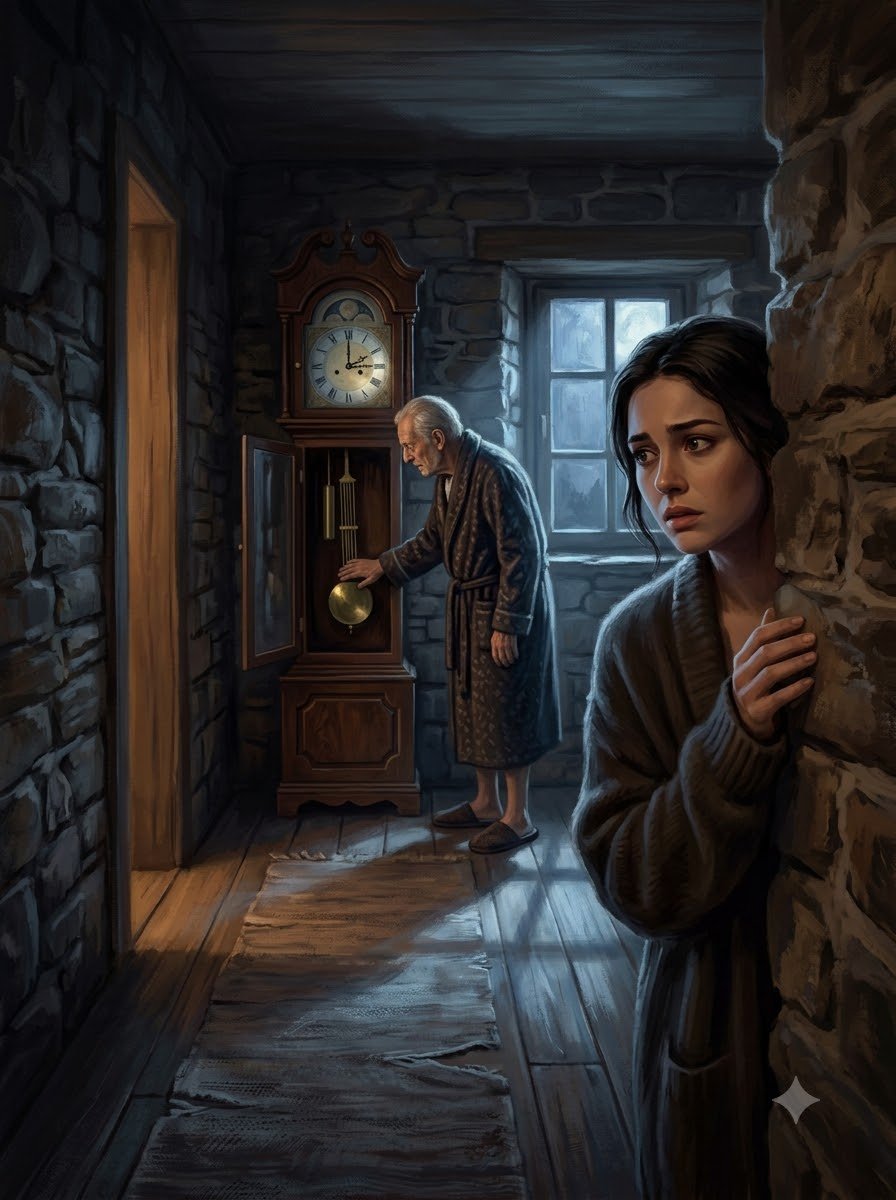
Every night, the old grandfather clock in the Whitfield hallway stopped at exactly 3:17. Nobody would tell new babysitter Maya Brooks why — until a six-year-old’s innocent question led her to a key hidden inside the clock, thirty years of secret payments, and a girl the whole town believed had drowned. Read all 8 chapters below.
A Midnight Chapters original story. All characters and events are fictional.
Chapter 1: The Clock That Stopped Every Night
The first time I noticed it, I thought the clock was simply broken.
It was my third morning working for the Whitfield family in their big stone house above Asheville. I came in at seven, as always, to get six-year-old Theo ready for school, and the tall walnut grandfather clock at the end of the hallway was silent. Its brass pendulum hung perfectly still. The hands pointed to 3:17.
By the time I’d made Theo’s pancakes, someone had wound it again. It ticked all day, deep and steady, like a heartbeat in the walls.
The next morning, it was stopped at 3:17 again.
And the next.
“Why does Grandpa’s clock always stop at the same time?” Theo asked on Friday, swinging his legs under the kitchen counter. He said it the way six-year-olds say everything, loud and completely unbothered.
The kitchen went quiet.
Daniel Whitfield, Theo’s father, was standing at the coffee machine in his work shirt. He was thirty-eight, a widower for three years, and the kind of tired that sleep doesn’t fix. He didn’t turn around. “It’s an old clock, buddy. Old things get stuck.”
At the end of the table, Theo’s grandfather, Walter, looked up from his oatmeal. He was seventy-eight, still broad-shouldered, with hands that had built half the furniture in the house. Early-stage dementia had softened the edges of him, but his eyes were sharp in that moment. Sharp and frightened.
“It isn’t stuck,” Walter said quietly. “It’s sleeping.”
“Dad,” Daniel said.
“She sleeps at three-seventeen,” Walter went on, as if Daniel hadn’t spoken. “So the clock sleeps too.”
Daniel set his mug down hard enough to slosh coffee onto the counter. “Maya, could you take Theo out to the car? We’re running late.”
I did what I was told. I was twenty-six, in my last year of nursing school, and this job paid my tuition. I wasn’t going to lose it over a clock.
But that night I couldn’t stop thinking about the way Walter had said she.
At 3:10 a.m., I was awake on the pull-out bed in the guest room, where I stayed on the nights Daniel worked late shifts at the lumber mill. The house was dark and silent except for the clock. I don’t know what made me get up. I just did.
I stood at the corner of the hallway in my socks and watched.
At 3:16, Walter’s bedroom door opened. He shuffled out in his robe, crossed to the clock, opened the narrow glass door on its case, and laid two fingers gently against the pendulum. It swung once more, slowed, and stopped.
3:17.
“Goodnight, Clairey,” he whispered. “Daddy’s sorry.”
I must have made a sound, because he turned. In the gray light from the window, his face crumpled with something that looked like terror. He crossed the hallway faster than I thought he could move and grabbed my wrist.
“You can’t tell Gordon,” he hissed. “You can’t tell Gordon she’s still sleeping.”
Chapter 2: The Girl in the Lake Photograph
Walter didn’t remember any of it in the morning. He asked me if I’d seen his reading glasses, then asked again ten minutes later.
I waited until Daniel came home from the mill that evening. Theo was in the bath, singing a song about sharks, and Daniel was standing at the sink staring at nothing.
“Who’s Claire?” I asked.
His shoulders went rigid. For a long moment I thought he was going to fire me on the spot.
Instead, he dried his hands, walked into the den, and came back with a framed photograph I’d never seen. It must have been kept in a drawer. A family stood on a wooden dock on a lake: a younger, laughing Walter; a woman with a sunhat; a skinny boy of about eight with a fishing rod; and a little girl with a gap-toothed grin and two crooked braids.
“My little sister,” Daniel said. “Claire. She was six.”
“What happened?”
“She drowned. Lake Lure, July 1996. We were up at the cabin for the summer.” He said it flatly, like a sentence he’d rehearsed until it stopped hurting. “My mom was sick, my dad was working, I was supposed to be watching her and I wasn’t. She went down to the water alone. They searched for three days. They never found her.”
“I’m so sorry.”
“The clock in the cabin stopped that afternoon,” he said. “Three-seventeen. Dad brought it here when we sold the place. He’s been stopping it every night for thirty years. My mom hated it. Before she died, she begged him to let it run.” He shook his head. “It got worse after his diagnosis. Now he thinks Claire’s… somewhere. Sleeping. The doctors say it’s the disease.”
He handed the photo back to me as if it weighed too much. “Please don’t encourage it, Maya. He gets agitated.”
I nodded. But I kept looking at the photograph.
“Who’s Gordon?” I asked.
Daniel frowned. “My uncle. Dad’s younger brother. He runs Whitfield Lumber now. Why?”
“Your dad mentioned him last night.”
Something flickered in Daniel’s face, then disappeared. “Uncle Gordon handled everything after Claire. The search, the lawyers, the press. Dad couldn’t function.” He exhaled. “He’s coming to dinner on Sunday. He wants to talk about moving Dad to a memory care facility. And about selling the mill.”
That night, after Daniel left for his late shift, I put Theo to bed and checked on Walter, who was asleep in his armchair with the TV murmuring. Then I went to the clock.
I told myself I was only going to look.
The case was old and beautiful, hand-carved walnut with a brass plate engraved W.W. 1981. Walter had built it himself. I opened the glass door and ran my hand along the inside of the cabinet, behind the pendulum, where the wood was rough and unfinished.
My fingers brushed something taped to the back panel.
A small brass key, wrapped in yellowed masking tape. And written on the tape, in shaky ballpoint, was a single word.
SUNDAYS.
Chapter 3: What Was Inside the Clock
I lay awake half the night holding that key.
In the morning, while Theo was at school and Walter was watching a game show, I helped him organize his closet. It was something the family had asked me to do anyway; Walter had started hiding things. On the top shelf, behind a stack of flannel shirts, I found a gray metal lockbox.
The brass key fit perfectly.
I knew I should stop. I knew it wasn’t mine to open. But I kept hearing Walter whisper Daddy’s sorry, and I turned the key.
Inside were envelopes. Hundreds of them, bundled in rubber bands by year. The oldest were dated 1996. The newest was dated last month.
Every envelope was a monthly statement from the same place: Laurel Ridge Residential Care, Burnsville, North Carolina.
Resident: C. Ward.
Long-term residential and rehabilitative care. Monthly balance: paid in full.
At the bottom of the box was a sheet of thick drawing paper. Someone had painted a clock with watercolors, carefully, every numeral in place. The hands pointed to 3:17. In the corner, in wobbly capital letters, was a signature:
CLAIRE.
The date beside it was from last spring.
My hands were shaking when Daniel walked in from the garage. He’d come home early. He saw the open lockbox on the bed, the envelopes, my face. “What are you doing in my father’s—”
I held up the painting.
He took it from me. I watched him read the name in the corner. I watched the color leave his face, inch by inch, until he had to sit down on the edge of the bed.
“That’s her handwriting,” he whispered. “She always made the R backwards. She’d just learned to write her name the summer she—” He stopped.
He picked up one of the statements. Then another. Then a whole bundle, flipping through thirty years of dates.
“Laurel Ridge,” he said. “C. Ward. Ward was my mother’s maiden name.”
“Daniel,” I said carefully, “I think your dad hasn’t been confused at all. I think every Sunday for thirty years, he went somewhere.”
Daniel stared at the statements. “He used to take the truck out every Sunday morning. Said he was going fishing. Never brought home a single fish. Mom used to joke about it.” His voice cracked. “He stopped last year when the doctor took his license away.”
He looked up at me, and I saw an eight-year-old boy on a dock.
“My father told us there was nothing left to bury,” he said. “He stood at an empty grave and let my mother die believing her daughter was at the bottom of a lake.”
Chapter 4: Uncle Gordon Comes to Dinner
We agreed to say nothing until we understood what we’d found. Daniel called Laurel Ridge on Saturday morning, but the receptionist said she couldn’t discuss residents with anyone not listed as family or guardian. When Daniel asked who was listed, she hesitated and hung up.
On Sunday, Gordon Whitfield arrived at six o’clock sharp in a silver Mercedes.
He was sixty-nine, tanned and silver-haired, in a quarter-zip that probably cost more than my rent. He hugged Daniel, ruffled Theo’s hair, and kissed Walter on top of the head like a son instead of a brother. He shook my hand and held it a second too long.
“So you’re the nursing student,” he said. “Daniel says you’re wonderful with Dad.”
“Walter’s easy to care for,” I said.
“For now.” He smiled sadly. “That’s what we need to talk about.”
Dinner was roast chicken. Gordon did most of the talking. There was a buyer for Whitfield Lumber, a national company out of Atlanta. The deal would close in three weeks. Everyone would be comfortable. And there was a wonderful memory care facility in Arizona, close to Gordon’s winter home, where Walter could get “the very best care.”
“Arizona,” Daniel repeated.
“Dry air, sunshine, top doctors.” Gordon cut his chicken neatly. “And honestly, Danny, it would be good for Dad to get away from… all this.” He glanced toward the hallway, toward the clock. “This house is full of ghosts. It’s not healthy for him to keep living in 1996.”
At the head of the table, Walter had stopped eating. His hands were trembling around his fork.
“Gordie,” Walter said. “Did you go see her? You promised you’d go on Sundays if I couldn’t.”
The silence was enormous.
Gordon set down his knife. His smile didn’t move, but his eyes went very flat. “Dad’s having a bad night,” he said to Daniel, as if Walter weren’t there. “This is exactly what I mean.”
“I’m not having a bad night,” Walter said, and his voice was suddenly strong. “Did you go see Claire?”
Theo looked up from his plate. “Who’s Claire?”
Gordon pushed back his chair and smiled at Theo. “Nobody, champ. Grandpa’s just tired.” He turned to me. “Maya, maybe you could help Dad get ready for bed?”
I helped Walter to his room. When I came back down the hall, I heard Gordon’s voice through the half-open door of the den, low and urgent. He was on the phone.
“No, I don’t know how much he’s said. The kid’s asking questions now, and the girl they hired is sharp.” A pause. “Then move her. I’m her legal guardian, I’ll sign whatever you need. Tonight, if you have to. Just get her out of Laurel Ridge before anyone shows up there.”
Chapter 5: The Drive to Laurel Ridge
Gordon left at nine. Daniel stood at the window watching his taillights disappear down the mountain road, his jaw tight.
When I told him what I’d heard, he didn’t say a word. He just walked to the hall closet and grabbed his keys.
We left Theo with Mrs. Alvarez next door, a retired schoolteacher who adored him and asked no questions when Daniel knocked on her door at 9:30 on a Sunday night. Then we drove.
Burnsville was an hour and forty minutes into the mountains, all switchbacks and dark pine trees. Daniel drove with both hands locked on the wheel. Neither of us spoke for the first forty minutes.
“What if it’s not her?” he finally said. “What if Dad was paying for some stranger? Some charity case? What if I walk in there and—”
“Then we’ll know,” I said.
“And if it is her?” His voice broke. “Then my father lied to me every day of my life. My mother died grieving a child who was alive two hours away.”
I didn’t have an answer for that. I put my hand on his arm, and he let it stay there.
Laurel Ridge Residential Care was a long, low brick building at the end of a gravel road, with a covered porch and wind chimes. The front doors were locked. Through the glass, I could see a woman in purple scrubs at the nurses’ station.
Daniel pressed the buzzer. She came to the door but didn’t open it. Her name tag said BERNADETTE, RN. She was in her sixties, with reading glasses on a beaded chain.
“Visiting hours ended at eight,” she said through the glass.
“Please,” Daniel said. “My name is Daniel Whitfield. I think my sister lives here. Claire. You’d have her under the name Ward.”
Bernadette’s face changed. She looked at him for a long time, studying his face the way you’d study a photograph.
“Walter’s boy,” she said softly. “You have his eyes.” She unlocked the door. “Your father used to sit with her every Sunday for twenty-nine years. Never missed one, not even in snowstorms. When he stopped coming last year, I wondered if he’d passed.”
“He’s alive,” Daniel said. “He has dementia.”
Bernadette nodded slowly. Then she looked over her shoulder and lowered her voice. “You should know a man called here an hour ago. Said he was her guardian and was arranging an emergency transfer tomorrow morning. Gordon something.”
“Please,” Daniel said. “Can I see her?”
Bernadette led us down a quiet hallway that smelled like lavender and floor polish. She stopped at the last door and knocked gently. “Claire, honey? You’ve got visitors.”
The room was small and warm and covered in paintings. Dozens of them, taped to every wall. Clocks. Lakes. A dock. Two children holding fishing rods.
A woman sat at an easel by the window. She was thirty-six, thin, with long brown hair in two loose braids and a faint scar running from her temple into her hairline. She held a paintbrush in her left hand. Her right hand rested curled in her lap.
She looked at Daniel. She tilted her head.
Then, slowly, in a voice that sounded rusty from disuse, she began to hum. It was a silly, off-key tune, the kind of song a big brother makes up to get his little sister to stop crying.
Daniel made a sound I’ll never forget.
“Danny,” Claire said. “You got tall.”
Chapter 6: What Happened at 3:17
We stayed until almost two in the morning. Claire tired quickly. She had a traumatic brain injury, Bernadette explained, with weakness on her right side and trouble finding words when she was overwhelmed. But she remembered things. The lake. The dock. Her brother. She called Daniel “Danny” again and again, as if testing that the word still worked, and fell asleep holding his hand.
In the staff room, over bad vending-machine coffee, Bernadette told us what she knew.
Claire had been admitted in August 1996 after weeks in a private hospital in Charlotte. Her records listed a “road accident.” She’d been placed under the name Claire Ward, with a guardian of record: Gordon Whitfield. All payments came from a private account. All visits came from Walter, every Sunday, always alone.
“I asked him once why her mother never came,” Bernadette said. “He just cried. I never asked again.”
We drove home in silence as the sky turned gray. Walter was awake when we came in, sitting in his armchair, staring at the stopped clock. For once, he looked completely clear.
Daniel knelt in front of him and set Claire’s newest painting on his knees.
“We saw her, Dad,” he said quietly. “We saw Claire.”
Walter’s face folded. He cried for a long time. And then, in a steady voice, he told us the truth.
On July 14, 1996, Gordon had been drinking at the marina all afternoon. He’d taken Walter’s truck to get more beer. On the gravel road that ran beside the lake, he came around a blind curve too fast and hit a little girl in a yellow swimsuit who had wandered up from the dock looking for her daddy.
It was 3:17. Walter knew because the clock in the cabin, the one he’d built, was in the truck bed, on its way to be repaired. The impact jolted it so hard the pendulum snapped off.
Walter had heard the brakes from the boathouse and ran. He found Gordon kneeling in the gravel, sobbing, Claire unconscious and bleeding.
“She was alive,” Walter whispered. “I held her. She was alive.”
Gordon begged him. If Gordon went to prison, the company would collapse. Whitfield Lumber employed three hundred people. Walter’s wife, Ruth, was in the middle of chemotherapy, and their insurance ran through the company. Gordon had a friend, a surgeon in Charlotte. He’d take Claire there himself, privately. He’d handle everything.
“I said yes,” Walter said. “God forgive me. I was so scared, and Ruth was so sick, and Gordon said if the police came, they’d take Claire from us anyway. He said she might not live through the night.” He wiped his face. “By the time I understood she would live, Gordon had already told the sheriff she’d drowned. He’d already called the search teams. He’d already made me sign papers. If I told the truth, I’d go to prison for covering it up, and he said he’d make sure Danny went into foster care.”
“So you let Mom grieve,” Daniel said.
“I let everyone grieve,” Walter whispered. “And I stopped the clock. Every night, at the minute I lost her. So I would never let myself forget what I did.”
Daniel’s phone buzzed on the coffee table. It was 7:02 a.m. The screen said LAUREL RIDGE.
It was Bernadette. Her voice was tight.
“He’s here,” she said. “Your uncle. He’s got a medical transport van and a stack of papers, and he says he’s taking her to Arizona today.”
Chapter 7: The Transfer Papers
Daniel drove. I made phone calls.
First, the Yancey County Sheriff’s Office. Then Adult Protective Services. Then Mrs. Alvarez, to ask if she could keep Theo a few more hours. Walter sat in the back seat clutching the lockbox to his chest like a life preserver.
“Everything’s in here,” he kept saying. “Everything. I kept it all.”
He had. Under the statements, in a sealed envelope, was a letter Walter had written in 1997 and never sent, describing the accident in detail. Under that was something even more important: a single typed page on Whitfield Lumber letterhead, dated July 20, 1996, signed by Gordon Whitfield, laying out “the arrangement.” Private care. A new name. Monthly payments funneled through a company account. Silence.
Gordon had made Walter sign it too, as insurance. He’d probably forgotten Walter kept a copy.
When we pulled into the gravel lot at Laurel Ridge, a white medical van was parked by the front entrance with its back doors open. Gordon’s Mercedes was beside it.
Inside, voices were raised. Gordon stood at the nurses’ station in a navy blazer, waving a folder at Bernadette, who had planted herself in front of the hallway like a wall.
“I am her legal guardian,” he was saying. “I have every right to—”
“She’s not going,” Bernadette said.
“You’ll lose your license.”
“Then I’ll lose it.”
Gordon turned and saw us. For a split second, his face showed nothing at all. Then the warm uncle smile slid back into place. “Danny. Dad. Thank God. This woman is being completely unreasonable. Claire needs specialized care I’ve arranged in—”
“You told everyone she drowned,” Daniel said.
“Danny, you don’t understand what happened. Your father—”
“I understand perfectly.” Daniel’s voice was quiet and very cold. “Dad told us. And he kept your letter.”
Walter stepped forward and held up the typed page with his shaking hand. Gordon saw his own signature, and the color drained from his face.
Down the hallway, a door opened. Claire stood in it, holding onto the frame with her good hand, her braids loose over her shoulders. She looked at Gordon for a long moment.
Then she shook her head. “No,” she said clearly. “Not you.”
She reached for my hand instead, and I took it.
The sheriff’s deputies arrived eleven minutes later. Gordon tried to leave. He didn’t get past the porch.
There would be investigations: fraud, forgery, years of falsified guardianship reports, thirty years of company money moved through hidden accounts. The lawyers would spend months arguing about what could still be charged after three decades. But that morning, none of that mattered.
What mattered was that Claire stayed exactly where she was, holding my hand on one side and her brother’s on the other, while her father sat in a plastic chair by her bed and cried, and she patted his gray head and said, “It’s okay, Daddy. I’m awake now.”
Chapter 8: The Clock Runs Again
Seven months later, on a bright afternoon in June, the Whitfield house was louder than it had been in thirty years.
Claire lived with us now, in the downstairs bedroom Daniel had renovated with wide doorways, grab bars, and a big window facing the garden. Bernadette, newly retired, came three days a week as her private nurse and spent most of that time teaching Theo to play gin rummy. Claire painted every morning. She had moved on from clocks. These days it was mostly gardens, and lately, a lot of yellow umbrellas, though she wouldn’t tell anyone why.
The sale of Whitfield Lumber had collapsed the week Gordon’s arrest made the news. Daniel stepped in to run the mill. He cleaned out the books, kept every one of the three hundred jobs, and quietly set up a fund in Claire’s name for families dealing with brain injuries.
Walter had good days and hard days. On the good days, he sat with Claire on the back porch for hours. They didn’t always talk. Sometimes he just held her left hand, and she let him.
I had graduated from nursing school in May. I’d been offered a job at Mission Hospital in Asheville, and I’d taken it, and somehow I’d never quite moved out of the Whitfield guest room. Neither of us had brought it up. Neither of us needed to.
At 3:15 that afternoon, Theo came running down the hallway in his socks, sliding on the hardwood. “Dad! Maya! Aunt Claire! Grandpa! It’s almost time!”
We all gathered in front of the grandfather clock: Walter in his armchair, which we’d dragged into the hall; Claire beside him in her wheelchair; Bernadette with a camera; Daniel; Theo, bouncing on his toes; and me.
Walter had spent the past month restoring the clock with Daniel’s help, his old hands guided by his son’s younger ones. New gears. A new mainspring. And, for the first time since 1981, the chime.
The minute hand crept forward. 3:16.
Walter reached over and took Claire’s hand.
3:17.
The clock didn’t stop. Instead, deep inside the walnut case, a hammer lifted and fell, and a warm bronze note rang through the house. Then another. Then another.
Claire laughed, a real laugh, bright and surprised and young. Walter put his face in his hands.
Theo tugged on my sleeve and leaned in to whisper, the way he always did when he thought something was very important.
“Grandpa said the clock was sleeping so the girl could sleep,” he said. “So now that Aunt Claire’s awake, the clock gets to be awake too. Right?”
“Right,” I said, my eyes stinging.
Daniel slipped his hand into mine, the way he’d started doing lately when he thought no one was looking. Everyone was looking. Nobody minded.
Behind us, the clock kept ticking. Steady. Unstoppable. Exactly the way time is supposed to move.
The End.
Midnight Chapters publishes original fiction. All names, characters, and events in this story are imaginary. Any resemblance to real persons or events is coincidental.